
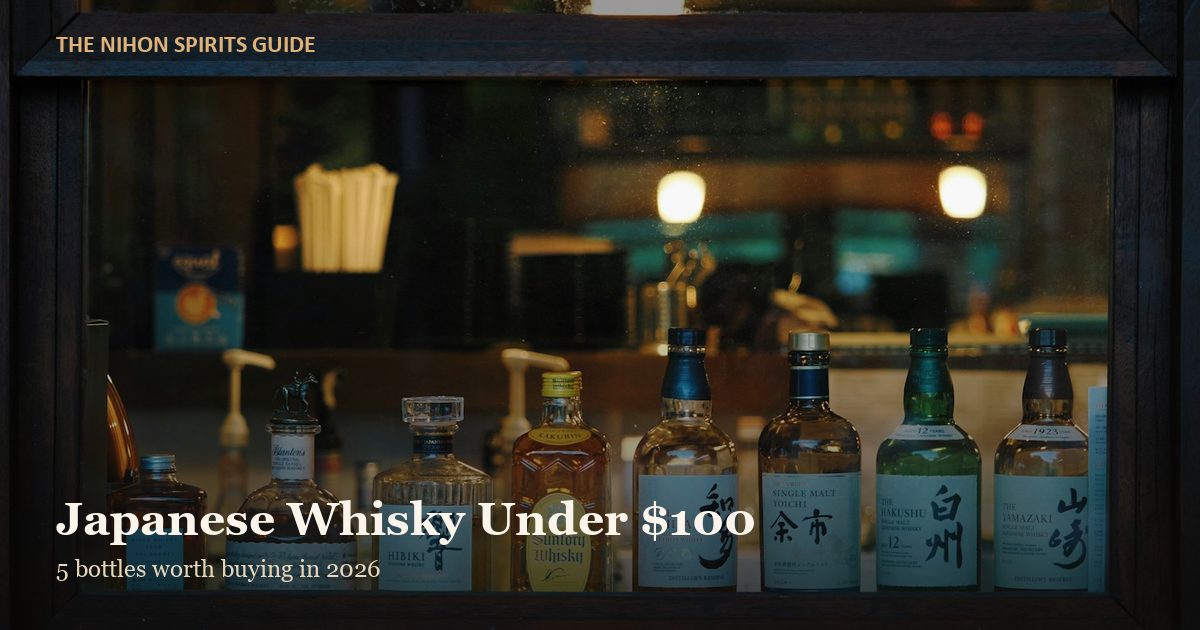
Quick answer: the best Japanese whisky under $100 is Suntory Toki if you only want one bottle. It is the easiest of the five to find, holds up in a highball, and sits at the low end of this list price-wise. Keep reading for the other four, because “best” depends heavily on how you actually plan to drink it.
Japanese Whisky Under $100: Comparison at a Glance
| Bottle | Price (750ml) | ABV | Best For |
|---|---|---|---|
| Suntory Toki | ~$30–40 | 43% | Highballs, first bottle |
| Mars Iwai Tradition | ~$25–40 | 40% | Best value |
| Nikka Coffey Grain | ~$60–70 | 45% | Sipping neat, smoothness |
| Nikka From the Barrel | ~$70–80 | 51.4% | Bold flavor, cocktails with backbone |
| The Kurayoshi Sherry Cask | ~$85 | 43% | Sherry-cask fans |
Prices vary by state and retailer and change often — treat these as a starting point, not a quote.
1. Suntory Toki — Best Overall
Toki is a blend of malt whisky from Yamazaki and Hakushu plus grain whisky from the Chita distillery, and Suntory built it specifically with highballs in mind. That focus shows: it stays bright and citrusy even cut with soda water, which is more than most whiskies in this price range can say. We go deeper on it, including how it compares to the newer Toki Black, in our full Suntory Toki review.
On its own, expect lemon oil and grain up front, honeysuckle and caramel underneath, and a light, slightly herbal finish. It is not a complex sipping whisky, and it is not trying to be one.
Pros:
- Widely stocked — the easiest of the five to actually find outside Japan
- Holds its character in a highball better than most blends this price
- Approachable if you have never tried Japanese whisky before
Cons:
- Thin on its own without ice or a mixer
- Not much depth for whisky drinkers who want a slow sipper
Bottom line: the safest first bottle, and the one to keep stocked for mixed drinks. Shop it at The Whisky Exchange →
2. Mars Iwai Tradition — Best Value
Mars is the smallest of Japan’s major whisky makers, and Iwai Tradition is where they put their money where their mouth is on price. The mash bill leans malt-heavy (75% malted barley), aged across ex-bourbon, sherry, and wine casks, which gives it more going on than the price tag suggests.
Expect ripe cherry and honey toffee with a ginger-spice kick, plus banana, orange peel, and burnt brown sugar as it opens up. It is drier than a lot of entry-level blends, which some drinkers prefer and others find less immediately friendly than Toki.
Pros:
- Usually the cheapest bottle on this list
- More flavor complexity than the price suggests
- Good in cocktails that call for a whisky with some backbone
Cons:
- Less consistent availability than Toki in some regions
- The dryness can read as thin to drinkers used to bourbon
Bottom line: the pick if budget is the deciding factor and you still want something with character. (Buy link coming soon — Mars Iwai Tradition isn’t carried by our current retailer partner.)
3. Nikka Coffey Grain — Best for Sipping Neat
This is a grain whisky, not a malt, made using Nikka’s Coffey stills — a distillation method most brands reserve for blending components rather than a standalone release. Nikka bottles it on its own anyway, and it is smoother for it: expect vanilla, tropical fruit, coconut, and a soft, syrupy sweetness with a corn-forward finish.
It reads closer to a well-made bourbon than a Scotch-style malt, which makes it a good bridge bottle for bourbon drinkers curious about Japanese whisky.
Pros:
- Smooth enough to drink neat without much bite
- Distinct profile — does not taste like the other bottles on this list
- Approachable for bourbon drinkers specifically
Cons:
- Pricier than Toki or Iwai for a similar “everyday” use case
- The sweetness will not appeal to drinkers who want a drier, more austere whisky
Bottom line: the one to reach for if you want something easy to sip without ice. Shop it at The Whisky Exchange →
4. Nikka From the Barrel — Most Intense
Nikka blends this from over 100 different malt and grain whiskies, then bottles it at a hefty 51.4% ABV — noticeably stronger than everything else on this list. That strength is the point: it is built to stand up to a big ice cube or a splash of water without disappearing. We cover the 1985 origin story and the new 40th anniversary edition in our full Nikka From the Barrel review.
It is also, bottle for bottle, one of the better-regarded Japanese whiskies at any price, not just under $100 — it shows up on best-of lists well above this price bracket too.
Pros:
- Genuinely high-strength, high-intensity flavor for the price
- Respected well beyond just the “budget Japanese whisky” conversation
- Takes water or a large cube well without falling apart
Cons:
- The higher ABV is a lot if you are used to standard-strength whisky
- Pricing has crept up in some markets — check it is actually still under budget before buying
Bottom line: the pick for someone who already drinks whisky regularly and wants more intensity than Toki or Iwai offer. Shop it at The Whisky Exchange →
5. The Kurayoshi Sherry Cask — Best for Sherry-Cask Fans
Kurayoshi is made by the Matsui Shuzo brewery and finished in sherry casks, which puts it in a different lane from the other four bottles here — closer to a sherried Scotch than a typical Japanese blend. Expect dark fruit, toasted cocoa, banana bread, and a whisper of wood smoke, with citrus and sherry sweetness trading off through the finish.
If you already know you like sherry-cask Scotch, this is the most direct equivalent on this list. If you do not, it is probably not the bottle to start with.
Pros:
- Distinct sherry-cask profile you will not get from Toki, Iwai, or the two Nikkas here
- Good entry point into Japanese whisky for Scotch drinkers specifically
Cons:
- The most expensive bottle on this list
- Sherry-forward profile is polarizing if that is not your usual style
Bottom line: the one to get if you already know you like sherried whisky and want a Japanese take on it. Shop it at The Whisky Exchange →
Which One Should You Buy?
The right Japanese whisky under $100 depends on how you plan to drink it:
- New to Japanese whisky and want something mixable: get Suntory Toki.
- Watching your budget but still want real flavor: get Mars Iwai Tradition.
- Coming from bourbon and want a smooth neat pour: get Nikka Coffey Grain.
- Already a whisky drinker who wants intensity: get Nikka From the Barrel.
- You know you like sherry-cask Scotch: get The Kurayoshi Sherry Cask.
FAQ
Is Japanese whisky better than Scotch?
Neither is objectively better — they are different traditions. Japanese whisky tends to be more restrained and precise; Scotch has more regional variation from peated Islay malts to lighter Speysides. Try both and see what you actually prefer.
Why is Japanese whisky so expensive?
Some of it is. Age-stated single malts like Yamazaki 18 or Hibiki 21 spiked in price after international demand outgrew supply in the 2010s. The bottles on this list are blends without age statements, which is exactly why they stay under $100 while the famous names do not.
Can I drink Japanese whisky neat?
Yes, though some bottles are built for it more than others. Nikka Coffey Grain and Kurayoshi Sherry Cask are the two on this list best suited to sipping neat; Toki and Iwai are better with ice or soda.
Final Thoughts
If you take one thing from this list: Suntory Toki is the right default, and the other four are for when you know what you are looking for — more intensity, more sweetness, more sherry, or just a lower price. All five are genuinely available in the US under $100 as of this writing, which is not something you can say about most of the well-known Japanese whisky names anymore.
Prefer something lighter, or curious about Japan’s other national drink? Our guide to the best sake for beginners covers five bottles to start with. And once you’ve picked a bottle, our guide to the best glasses for Japanese whisky covers what to actually drink it out of. Curious how Suntory and Nikka actually differ as companies? See Nikka vs Suntory: Which Brand Should You Try First? Deciding specifically between the Suntory and Nikka picks on this list? Our Suntory Toki vs Nikka From the Barrel head-to-head compares those two bottles directly. And if you want to go deeper than a buying guide, our roundup of the best books about Japanese whisky and sake covers where to read more. Drinking one of these on the rocks? Our guide to ice ball molds for Japanese whisky covers how to keep it cold without watering it down. Want to confirm which of these five actually meet Japan’s JSLMA standard for genuine Japanese whisky? Our complete list of every whisky we’ve checked covers all of them directly.
