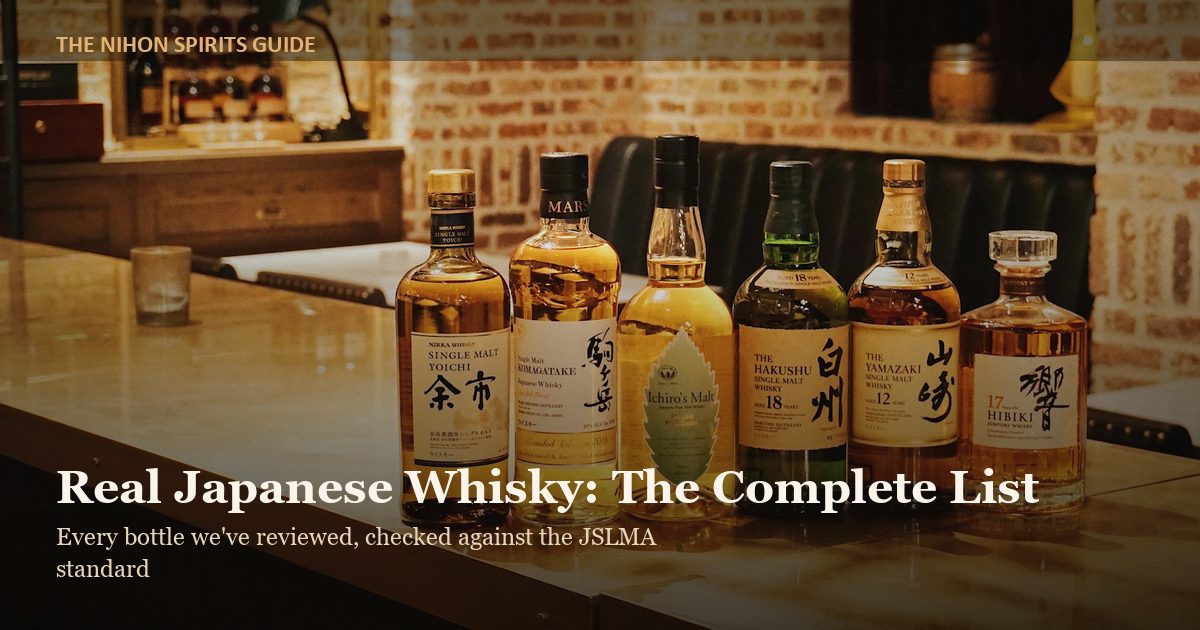
Quick answer: “Real” Japanese whisky isn’t defined by the label — it’s defined by a specific 2021 self-regulatory standard from the Japan Spirits & Liqueurs Makers Association (JSLMA), and most bottles on shelves today don’t advertise whether they meet it. Below is every bottle we’ve personally reviewed and checked against the standard, plus what to do about the ones we haven’t.
Some of the retailers we link to are partners who may pay us when you buy through them. This doesn’t change which bottles we recommend. How this works.
What “Real” Actually Means: The JSLMA Standard
Before 2021, “Japanese whisky” wasn’t a legally defined term in any enforceable sense. A company could import Scotch or Canadian whisky, blend or finish it in Japan, and sell it as Japanese whisky — entirely legally, and plenty of brands did. The Japan Spirits & Liqueurs Makers Association introduced a self-regulatory standard to close that gap, fully in force since April 2024. To carry the “Japanese whisky” label under JSLMA’s definition, a whisky must be:
- Made with malted grain, using water sourced in Japan
- Mashed, fermented, and distilled entirely at a Japanese distillery
- Aged in wooden casks of 700 liters or less, within Japan, for at least three years
- Bottled in Japan
- At least 40% ABV
It’s a self-regulatory standard, not a government law — there’s no legal penalty for a company that ignores it, unlike Scotch Whisky’s geographic-indication status in the UK. But it’s the closest thing the industry has to an agreed definition, and it’s specific enough to actually check a bottle against. House of Suntory’s own explanation of the standard is a good plain-language source if you want the definition straight from a major producer.
The Complete List: Every Whisky We’ve Reviewed, Checked Against the Standard
We only list bottles here that we’ve reviewed and checked directly — we’re not going to guess at brands we haven’t verified. Here’s where our eleven reviewed whiskies land:
| Bottle | JSLMA Compliant? | What We Found |
|---|---|---|
| Suntory Toki | Yes | Malt from Yamazaki and Hakushu, grain from Chita — all Japan-distilled and blended. See our deep-dive verification for the bottle-specific walkthrough |
| Suntory Kakubin | Yes | Blend of malt and grain whisky from Suntory’s own Yamazaki, Hakushu, and Chita distilleries, all distilled and aged in Japan |
| Nikka Coffey Grain | Yes | Distilled on Nikka’s own Coffey stills at Miyagikyo, matured roughly 12 years in used American oak |
| Nikka From the Barrel | No, contains some imported whisky | Nikka’s own Japanese product page says the blend uses some imported whisky alongside its Yoichi and Miyagikyo malt |
| Nikka Miyagikyo | Yes | Single malt distilled, aged, and bottled entirely at Nikka’s own Miyagikyo distillery near Sendai, matured mainly in sherry casks |
| Nikka Yoichi | Yes | Single malt distilled, aged, and bottled entirely at Nikka’s own coastal Yoichi distillery, using coal-fired pot stills |
| Hibiki Japanese Harmony | Yes | Blended from Yamazaki and Hakushu malt plus Chita grain whisky, all Japan-distilled and blended |
| Hakushu 12 | Yes | Single malt distilled and aged 12 years at Suntory’s own Hakushu distillery in the Japanese Alps |
| Yamazaki 12 | Yes | Single malt distilled and aged 12 years at Suntory’s Yamazaki distillery, Japan’s first, founded 1923 |
| Mars Iwai Tradition | Yes | Distilled at Hombo Shuzo’s own Shinshu distillery in Nagano — Japan’s highest-altitude whisky distillery |
| The Kurayoshi Sherry Cask | No — world blend | Malt partly sourced from Scotland, then blended and sherry-finished in Japan |
Ten out of eleven pass outright. The one that doesn’t isn’t a scam or a fake — it’s a real product from a real, century-old distiller that just doesn’t meet this particular standard, and we say so directly in its review.
World Blend Isn’t a Dirty Word
The industry has a real, non-derogatory term for whisky that blends Japanese-distilled spirit with malt imported from elsewhere: a world blend. It just means part of the whisky’s origin is outside Japan, which the JSLMA standard specifically excludes from the “Japanese whisky” label — it says nothing about whether the whisky is good.
The Kurayoshi Sherry Cask is the clearest example we’ve reviewed. Matsui Shuzo has been distilling in Tottori since 1910, and judged purely as a sherry-cask malt whisky at its price, it’s genuinely good — dark fruit, cocoa, and a hint of banana bread on the nose, sherry sweetness on the finish. It just isn’t JSLMA-compliant Japanese whisky, because part of its malt is sourced from Scotland before blending and finishing in Japan. Whether that matters to you depends on what you’re buying it for: it matters if you specifically want a bottle that’s Japan-distilled start to finish, for a gift, a collection, or your own preference. It doesn’t matter at all if you just want something good in the glass.
What About Sake? A Different Kind of “Real”
Sake doesn’t have a JSLMA-style controversy, because it isn’t governed by JSLMA at all — Japan’s National Tax Agency has regulated the specific-designation terms (Junmai, Ginjo, Daiginjo, and so on) since 1990, based on polishing ratio and whether alcohol is added, not on where the rice or water came from. Our sake grades guide covers those categories in full. The three sake bottles we’ve reviewed — Dassai 45, Dassai 23, and Hakkaisan Junmai Ginjo — are all brewed start to finish by their named breweries in Japan, so the “is this actually real” question that applies to some whisky simply doesn’t come up the same way here.
Checking a Bottle That’s Not on This List
We’re not going to name-and-shame brands we haven’t personally verified against the standard — that’s a real reputational claim, and we’d rather be right than fast. If you’re looking at a bottle that isn’t in the table above, our full guide to telling if a Japanese whisky is actually real walks through the checklist yourself: whether the label names a specific Japanese distillery, whether any age statement describes aging in Japan, whether the company has a checkable production history, and whether “world blend” language shows up anywhere in the marketing if you read closely.
How Does Real Japanese Whisky Compare to What You Already Drink?
Once you know a bottle is genuinely JSLMA-compliant, the natural next question is how it stacks up against whisky categories you already know. We’ve broken this down category by category rather than bottle by bottle, since the differences are structural — how the spirit is made, matured, and regulated — rather than about any one brand: Japanese whisky vs Scotch, Japanese whisky vs Bourbon, and Japanese whisky vs Irish whiskey.
Building a Home Bar for the Real Thing
Once you’ve settled on a bottle, how you drink it matters almost as much as which one you picked. Our Japanese whisky glasses guide and whisky decanters guide cover the accessories worth owning if you’re building this out as a proper home bar rather than just picking up a bottle for one night. Shopping for someone else? Our gift ideas that aren’t a bottle guide sidesteps the authenticity question entirely, and if the specific bottle you want is out of stock, our Hibiki Harmony alternatives guide covers other JSLMA-compliant options worth trying.
Shop at The Whisky Exchange: Yamazaki 12 · Hakushu Distiller’s Reserve · Hibiki Japanese Harmony · Suntory Toki · Nikka Yoichi · Nikka Miyagikyo · Nikka From the Barrel · Nikka Coffey Grain →
FAQ
Is there a government law defining “Japanese whisky”?
Not an enforceable one. The JSLMA standard is self-regulatory, adopted voluntarily by the industry association’s members, with full compliance expected since April 2024. It’s the best available benchmark, not a legal guarantee.
Does “world blend” mean a whisky is fake?
No — it describes where the malt came from, not quality or legitimacy. The Kurayoshi Sherry Cask is a real product from a real distiller; it just blends in malt sourced from Scotland, which the JSLMA standard doesn’t allow under the “Japanese whisky” label.
Which bottles on this list are the safest first buy if I specifically want JSLMA-compliant whisky?
Suntory Toki, Suntory Kakubin, and Nikka Coffey Grain are all widely available, reviewed on this site, and confirmed compliant — see our Japanese whisky under $100 guide for the full lineup. If you want a compliant single malt specifically, Hakushu 12, Yamazaki 12, Nikka Miyagikyo, and Nikka Yoichi are all confirmed compliant too.
Why isn’t [brand] on this list?
Because we haven’t personally checked its production against the JSLMA standard yet. We add bottles here only after reviewing them directly — check back as we review more.
Final Thoughts
The name on the bottle was never a reliable test, even before the JSLMA standard existed to make that official. Nine of the eleven whiskies we’ve reviewed meet it outright. The two that don’t, The Kurayoshi Sherry Cask and Nikka From the Barrel, are marked above, and both say so on their producers’ own pages rather than hiding it behind marketing copy. If you’re starting from zero, our Japanese whisky under $100 guide is the fastest way into bottles we’ve already checked.
