
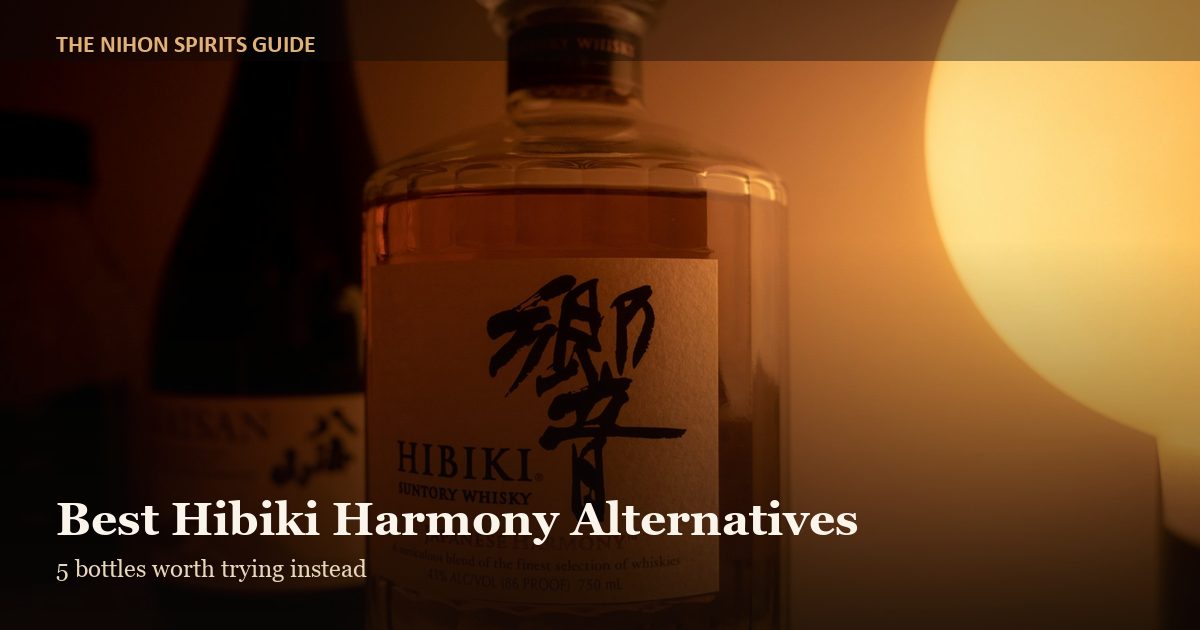
Quick answer: if Hibiki Harmony is sold out, marked up, or just more than you want to spend right now, the closest honest alternatives aren’t other Hibiki bottlings — they’re well-made blends built with the same “balance over intensity” philosophy at a third of the price. Suntory Toki is the nearest in spirit; Nikka Coffey Grain is the pick if what you actually liked was the honeyed sweetness.
Why People Look for a Hibiki Harmony Alternative
Hibiki Japanese Harmony blends malt whisky from Yamazaki and Hakushu with grain whisky from Chita, aged across five cask types including Mizunara oak, and it shows: orange peel, honey, white chocolate, and a whisper of smoke, all built around Suntory’s usual house priority of balance over any single loud note. MSRP generally lands in the $80–90 range for the standard bottle, but demand has kept it scarce enough that street prices run higher and it’s genuinely out of stock in a lot of markets a lot of the time.
None of the bottles below are literally the same whisky at a lower price — nothing is. What they share is the same basic idea Hibiki is built on: a smooth, approachable blend rather than a single-cask showpiece. If that’s what you actually wanted from Hibiki, these get you there without the scarcity tax. Three of the five are genuine JSLMA-compliant Japanese whisky; The Kurayoshi Sherry Cask and Nikka From the Barrel both include some whisky made outside Japan. See our complete list of every bottle we’ve checked for exactly which.
Hibiki Harmony Alternatives: Comparison at a Glance
| Bottle | Price (700–750ml) | Closest to Hibiki In | Best For |
|---|---|---|---|
| Suntory Toki | ~$30–40 | House style, Suntory blending philosophy | The nearest like-for-like substitute |
| Nikka Coffey Grain | ~$60–70 | Honeyed sweetness, easy sipping | If it’s the honey and vanilla you loved |
| The Kurayoshi Sherry Cask | ~$85 | Cask complexity, richer finish | If Hibiki’s cask variety is what drew you in |
| Nikka From the Barrel | ~$70–80 | Blending craft, just turned up | Wanting more intensity, not more subtlety |
| Mars Iwai Tradition | ~$25–40 | Multi-cask blending on a budget | Testing the waters before spending more |
Prices vary by retailer and change often — treat these as a starting point, not a quote.
1. Suntory Toki — The Nearest Like-for-Like Substitute
Toki comes from the same house as Hibiki, blending malt from Yamazaki and Hakushu with Chita grain whisky — structurally the same idea as Harmony, just built to a lower price point and a highball-first brief rather than a sipping-neat one. It’s thinner and less complex than Hibiki, but the DNA is genuinely the same. Our full Suntory Toki review covers how it holds up in detail.
Bottom line: if what you wanted from Hibiki was “the Suntory house style” rather than a specific flavor, this is it at roughly a third of the price. Shop it at The Whisky Exchange →
2. Nikka Coffey Grain — If It Was the Honey and Sweetness You Liked
Coffey Grain isn’t a Suntory product and isn’t trying to copy Hibiki, but the tasting notes overlap more than you’d expect: vanilla, honey, coconut, a soft sweetness that makes it easy to drink without ice. It’s a grain whisky rather than a malt-forward blend, so the texture is a little different, but if the appeal of Harmony was its gentleness rather than its complexity, this delivers that. Full details in our Nikka Coffey Grain review.
Bottom line: the pick if you want smooth and sweet over smooth and complex. Shop it at The Whisky Exchange →
3. The Kurayoshi Sherry Cask — If You Liked the Cask Variety
Hibiki’s use of five different cask types, including sherry, is part of what gives it that layered finish. Kurayoshi leans hard into sherry-cask character specifically — dark fruit, cocoa, banana bread — which isn’t the same profile as Hibiki but scratches a similar itch: a whisky whose complexity clearly comes from the wood, not just the base spirit. It’s covered alongside four other bottles in our Japanese whisky under $100 guide.
Bottom line: the closest thing here to Hibiki’s “the cask did a lot of the work” character, in a different direction. Shop it at The Whisky Exchange →
4. Nikka From the Barrel — More Intensity, Not More Subtlety
This is the honest outlier on this list: it’s not trying to be gentle the way Hibiki is. Blended from over 100 different malt and grain whiskies and bottled at a hefty 51.4%, it’s a genuinely different experience — bigger, bolder, built to take a large ice cube without disappearing. Worth including because some readers who think they want “something like Hibiki” actually want “something with that much blending craft behind it,” just without the restraint. Full story in our Nikka From the Barrel review.
Bottom line: pick this if you respect Hibiki’s blending pedigree but actually wanted more punch than polish. Shop it at The Whisky Exchange →
5. Mars Iwai Tradition — Best Budget Entry Point
Mars is Japan’s smallest major distiller, and Iwai Tradition is a malt-heavy blend (75% malted barley) aged across ex-bourbon, sherry, and wine casks — genuine multi-cask blending, just at a fraction of Hibiki’s price. It’s drier and less polished than Harmony, but it’s a legitimate way to see whether the general idea of a Japanese blended whisky is for you before spending real money. Covered in our Japanese whisky under $100 guide.
Bottom line: the one to try first if you’re not yet sure Japanese blends are worth the hype. (Buy link coming soon — Mars Iwai Tradition isn’t carried by our current retailer partner.)
Which Hibiki Harmony Alternative Should You Buy?
- Want the Suntory house style specifically: get Suntory Toki.
- Loved the honey and sweetness: get Nikka Coffey Grain.
- Loved the cask-driven complexity: get The Kurayoshi Sherry Cask.
- Want more intensity, not a Hibiki clone: get Nikka From the Barrel.
- Just testing the waters on a budget: get Mars Iwai Tradition.
FAQ
Is there a whisky that actually tastes like Hibiki Harmony?
Not exactly — Hibiki’s five-cask blend including Mizunara oak is genuinely distinctive. The bottles above share its general philosophy (balanced blend over single-cask intensity) rather than replicating its exact flavor.
Why is Hibiki Harmony so hard to find?
Demand has outpaced supply for most well-known Japanese whisky since the 2010s, and Suntory has been managing allocation carefully rather than scaling production to match hype. That scarcity is exactly why alternative bottles are worth knowing about.
Is Hibiki 17 or 21 a better option than Harmony?
They’re older, rarer, and priced well beyond this list — not really a fair comparison. If budget is the constraint that sent you looking for alternatives to Harmony, the older Hibiki bottlings will only make that worse.
Final Thoughts
Hibiki Harmony’s reputation is earned, but it’s not the only well-made Japanese blend on the market, and it’s often not even available when you want it. Start with Suntory Toki if you want the closest thing to the house style that made Hibiki famous in the first place, and see our Japanese whisky under $100 guide for the fuller picture on where each of these bottles fits.