

Quick answer: yes, this Mars Iwai Tradition review lands on worth it — it’s usually the cheapest bottle in any Japanese whisky lineup you’ll find it in, and it doesn’t taste like a budget afterthought. It’s drier and less immediately friendly than Suntory Toki, but the name on the label is honoring a genuinely important piece of Japanese whisky history, and the whisky backs that up.
The Man Behind the Name
Iwai Tradition isn’t a marketing name picked for how it sounds — it’s named after Kiichiro Iwai, and his role in Japanese whisky history predates the more famous names on this site. Iwai was Masataka Taketsuru’s direct superior at Settsu Shuzo, and it was Iwai who sent Taketsuru to Scotland in 1919 to study distillation — the trip that eventually led to Taketsuru founding Nikka, a story we cover in more depth in our Nikka vs Suntory guide. Iwai later designed the pot stills for Hombo Shuzo, a shochu maker founded in Kagoshima in 1872 that picked up a whisky distilling license in 1949, and he’s considered one of the founding figures of Japanese pot-still whisky in his own right — not just the person who sent someone else to Scotland.
Hombo Shuzo built the Shinshu distillery in Nagano in 1985 — at roughly 800 meters elevation, it’s the highest whisky distillery in Japan — then mothballed it entirely from 1992 to 2011 during a prolonged domestic whisky slump. Mars is genuinely the smallest of Japan’s major whisky makers, and that on-and-off history is a real part of why: it survived a stretch where several distilleries didn’t.
What It Actually Tastes Like
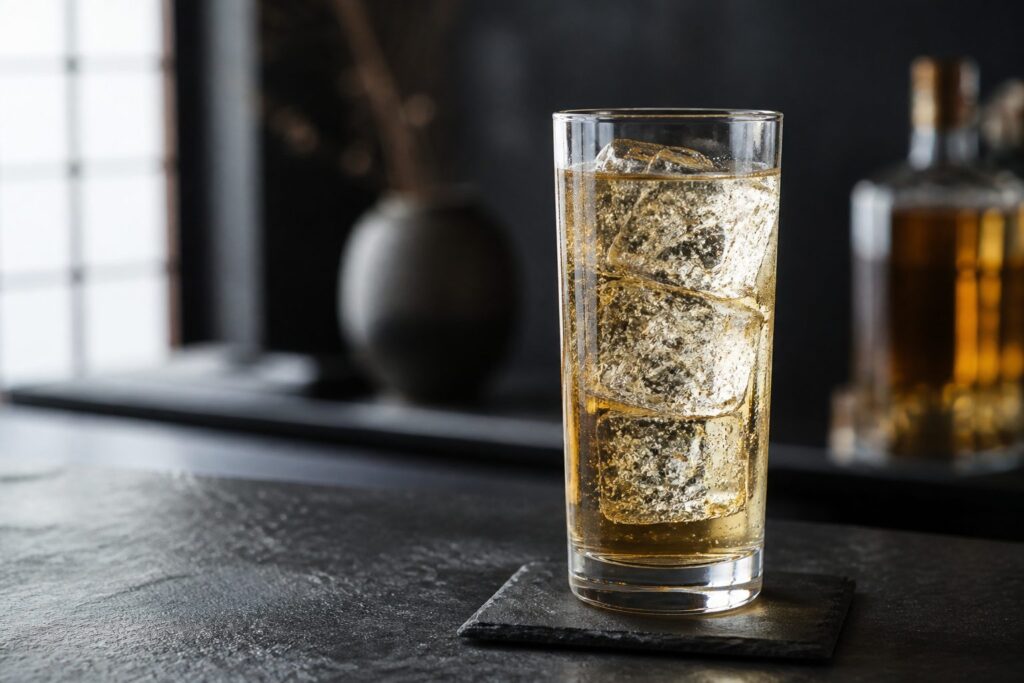
Iwai Tradition is a malt-heavy blend — 75% malted barley — aged across ex-bourbon, sherry, and wine casks, which gives it more going on than the price tag suggests. Expect ripe cherry and honey toffee up front with a ginger-spice kick, developing into banana, orange peel, and burnt brown sugar as it opens up. It’s noticeably drier than most entry-level Japanese blends, which some drinkers prefer and others find less immediately approachable than something like Suntory Toki.
That dryness is worth knowing going in if you’re used to bourbon’s sweetness — it can read as thin by comparison, even though the flavor complexity here is real for the price.
How to Actually Drink It
It holds up fine in cocktails that call for a whisky with some backbone, not just sweetness — the dryness and spice notes give a mixed drink more to work with than a rounder, sweeter blend would. Neat or on the rocks works too, though don’t expect the same immediate fruit-forward friendliness as Toki; this rewards a bit more attention.
Mars Iwai Tradition Review: Is It Actually Worth It?
Pros:
- Usually the cheapest genuine Japanese whisky you’ll find on a shelf
- Real flavor complexity from multi-cask aging, not just a thin budget blend
- Good in cocktails that need a whisky with some structure
- Backed by a genuinely significant piece of Japanese whisky history, not just a name
Cons:
- Less consistent availability than Toki or the bigger Suntory and Nikka names in some regions
- The dryness can read as thin to drinkers coming from bourbon
- Not the pick if you want an easy, obviously fruit-forward first bottle
FAQ
Is Mars a real Japanese whisky maker, or a budget knockoff brand?
Genuinely real, and arguably underrated — Hombo Shuzo has been distilling since 1949, and Kiichiro Iwai is a founding figure in Japanese whisky, not a marketing invention. Mars is just smaller and less internationally known than Suntory or Nikka. Iwai Tradition is also genuinely JSLMA-compliant — see our complete list of every whisky we’ve checked against the standard for how it lines up against the others.
Why did the Shinshu distillery shut down for almost 20 years?
Japan’s domestic whisky market collapsed through the 1980s and 90s as drinking habits shifted toward shochu and beer. Several distilleries mothballed production during that stretch; Shinshu reopened in 2011 as international interest in Japanese whisky picked back up.
How does this compare to Suntory Toki?
Toki is smoother, sweeter, and built specifically for highballs. Iwai Tradition is drier and more complex for the price, with more going on if you’re drinking it slowly rather than mixing it. Our Japanese whisky under $100 guide covers both side by side.
Final Thoughts
The short version of this Mars Iwai Tradition review: it’s the budget pick on this site’s Under $100 list that doesn’t taste like one, from a distillery with a real claim to being part of how Japanese whisky started in the first place. If dry, complex, and inexpensive sounds better to you than smooth and mixable, start here instead of Toki. For how it stacks up against four other bottles, see our Japanese whisky under $100 guide. (Buy link coming soon — we’re finalizing our retailer partnerships.)
Wondering whether this bottle still counts as a budget pick? Our Japanese whisky under $50 guide checks Iwai Tradition against current US retail prices, which have crept above $50 at several major retailers.