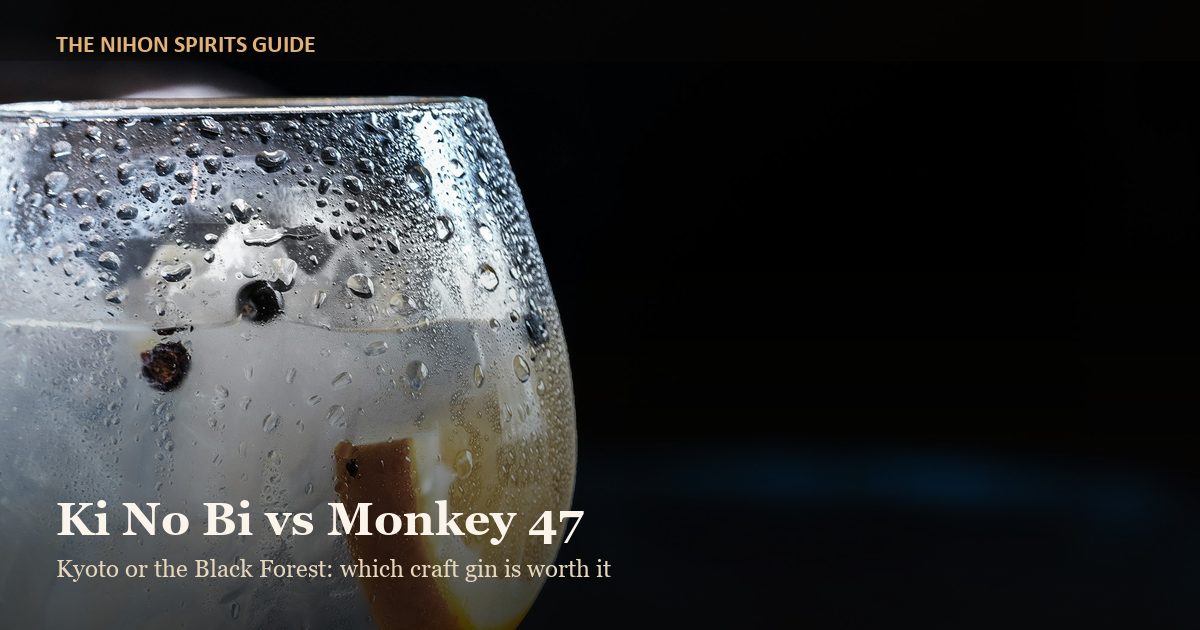
These two get compared because they occupy the same shelf: both are premium craft gins that sell on a sense of place, and both cost noticeably more than a London Dry. They are built very differently, though. One is a Kyoto gin with eleven botanicals and a rice base. The other is a German gin with 47 botanicals, a third of them from the forest around the distillery.
In this guide
Ki No Bi vs Monkey 47: Comparison at a Glance
| Ki No Bi Kyoto Dry Gin | Monkey 47 Schwarzwald Dry Gin | |
|---|---|---|
| Made in | Kyoto, Japan (The Kyoto Distillery) | Black Forest, Germany (Black Forest Distillers) |
| Launched | 2016 | 2010 |
| ABV | 45.7% | 47% |
| Base spirit | Rice spirit, cut with Fushimi groundwater | Molasses-based neutral spirit, local spring water |
| Botanicals | 11, in 6 groups distilled separately | 47, about a third from the Black Forest |
| Signature notes | Yuzu, sansho, gyokuro tea, red shiso, ginger | Juniper, spruce, lingonberry, citrus peel, lavender |
| Bottle size | 70cl (UK) / 750ml (US) | 50cl (UK) / 375ml (US) |
| Price checked Oct 2026 | £49.75 / 70cl at The Whisky Exchange; $60–86 / 750ml in US stores | £42.25 / 50cl at The Whisky Exchange; $38–47 / 375ml in US stores |
| Best for | Gin and soda, light gin and tonic, sipping on ice | Martini, Negroni, a gin and tonic that still tastes of gin |
How Each Gin Is Made
Ki No Bi: six groups, distilled one at a time
Ki No Bi comes from The Kyoto Distillery, and its maker describes it as the first gin made in Kyoto. The base is a rice spirit, and the water is groundwater from Fushimi, the city's sake-brewing district. According to the distillery's own product page, the eleven botanicals are split into six groups and each group is distilled on its own before blending:
- Base: juniper, orris root, akamatsu (Japanese red pine)
- Citrus: yuzu, lemon
- Herbal: sansho pepper, kinome (sansho leaf buds)
- Spice: ginger
- Tea: gyokuro green tea from Uji
- Fruity and floral: bamboo leaves, red shiso leaves
The yuzu comes from the north of Kyoto Prefecture, and the gyokuro from Uji, the tea district just south of the city. Distilling the groups separately lets the blender set how much yuzu or tea ends up in the glass, which is why Ki No Bi tastes more like a few clear notes than one dense one.
Monkey 47: a long maceration and 100 days in earthenware
Monkey 47 is made at Black Forest Distillers in Loßburg, in Germany's Black Forest, and launched in 2010. The brand story traces the recipe back to Montgomery Collins, a British Royal Air Force officer who settled in the region in the 1950s. The brand is now majority-owned by Pernod Ricard.
The production is slower than most gins. As Difford's Guide describes it, fresh ground lingonberries are macerated for 30 days in neutral spirit and spring water before the other botanicals go in, which include spruce, elderflower, blackthorn and bramble leaves from the forest along with bitter orange, lemon and pomelo peel. Lavender, grapefruit and lemon peel go in a separate basket in the still. The distillate then rests for 100 days in 1,000-liter earthenware vessels before it's bottled at 47%.
Taste: Bright and Separate vs Dense and Layered
The distillery's tasting notes for Ki No Bi start with yuzu and sansho on the nose, put juniper in a supporting role on the palate, and finish warm from the ginger with a trace of gyokuro tea. Even at 45.7%, it reads as a lighter, more aromatic gin. That's the reason its house serve, the Ki No Bi Sonic, uses less tonic than a standard gin and tonic: more mixer and the citrus and tea notes thin out.
Monkey 47 is the opposite in structure. With 47 botanicals, no single one stands out for long. What that list adds up to is a full, piney, juniper-forward gin with citrus peel and a tart berry edge. It's the more forceful of the two, and its strength and density suit stirred drinks, where a lighter gin can disappear behind vermouth or Campari.
The Price Trap: Check the Bottle Size
Monkey 47 looks like the cheaper bottle on the shelf, and it isn't. In the UK it's sold in a 50cl bottle, not the usual 70cl, and US stores commonly sell it as a 375ml half bottle.
- UK: Monkey 47 at £42.25 per 50cl works out to about £59 for the same 70cl you get from a £49.75 bottle of Ki No Bi.
- US: a 375ml Monkey 47 runs $38–47, or $76–94 for 750ml worth of gin. Ki No Bi's 750ml bottle runs $60–86 where it's stocked.
So per milliliter, Ki No Bi is the cheaper of the two by roughly 10–20%, depending on the store. The catch with Ki No Bi is availability: US distribution is patchy, and many liquor stores don't carry it at all, which is where an online retailer that ships to you matters.
Who Should Skip Each One
Skip Ki No Bi if you make most of your gin drinks with a full measure of tonic or in a Negroni. Its yuzu and tea notes are its whole point, and heavy mixers cover them. A sturdier, cheaper gin does that job better.
Skip Monkey 47 if you don't like pine or juniper-forward gin, or if you want a bottle that tastes clearly Japanese. It is neither delicate nor regional in the way Ki No Bi is. And if you only want a gin for highballs, paying for a 47-botanical gin aged in earthenware doesn't make much sense.
Which One Should You Buy?
- You drink gin with soda, a light pour of tonic, or on a big ice cube: buy Ki No Bi.
- You mostly make martinis, Negronis or other stirred drinks: buy Monkey 47.
- You're buying a gift for someone who already owns the usual London Dry bottles: Ki No Bi, since the Kyoto botanicals make it the more unusual bottle, and the karakami-paper label (designed with Kira Karacho, part of a Kyoto karakami atelier founded in 1624) makes it look like one.
- You want the most gin for the money between the two: Ki No Bi, because of the bottle size.
Shop Ki No Bi or Monkey 47 at The Whisky Exchange. It's a UK retailer, so check that it ships to your country before ordering.
Comparing Ki No Bi with the other big Japanese gin instead? See Roku Gin vs Ki No Bi. For Roku against Western gins, see Roku vs Hendrick's and Roku vs Sipsmith.
FAQ
Is Ki No Bi better than Monkey 47?
Neither is better across the board. Monkey 47 is the stronger, denser gin and the better choice for stirred cocktails. Ki No Bi is lighter and more aromatic and is better with soda or a little tonic. Pick by how you drink gin.
Why is Monkey 47 sold in a smaller bottle?
Monkey 47's usual bottle is 50cl in Europe and 375ml in US stores, smaller than the 70cl or 750ml most gins use. That keeps the shelf price lower, but per milliliter it costs more than Ki No Bi in both markets.
What is Ki No Bi made from?
A rice spirit base, Fushimi groundwater, and eleven botanicals: juniper, orris root, akamatsu pine, yuzu, lemon, sansho pepper, kinome, ginger, gyokuro tea, bamboo leaves and red shiso. The botanicals are distilled in six separate groups and then blended.
Is there a stronger version of either gin?
Yes. Ki No Bi Sei is a higher-strength version of Ki No Bi at 54.5%, and Monkey 47 releases a limited Distiller's Cut each year with one extra botanical. Both cost more than the standard bottles.
Can you buy Ki No Bi or Monkey 47 on Amazon?
Not reliably in the US, where Amazon.com carries very few spirits. Specialist spirits retailers are the more dependable option for both.
Final Thoughts
Monkey 47 earns its reputation as a cocktail gin: it's dense, strong and slow-made, and it stays present in a martini. Ki No Bi is the better buy if you want a gin to taste on its own terms, and it's also the better value once you account for the bottle size. If you already own one of them, the other is different enough to be worth having on the shelf too.