
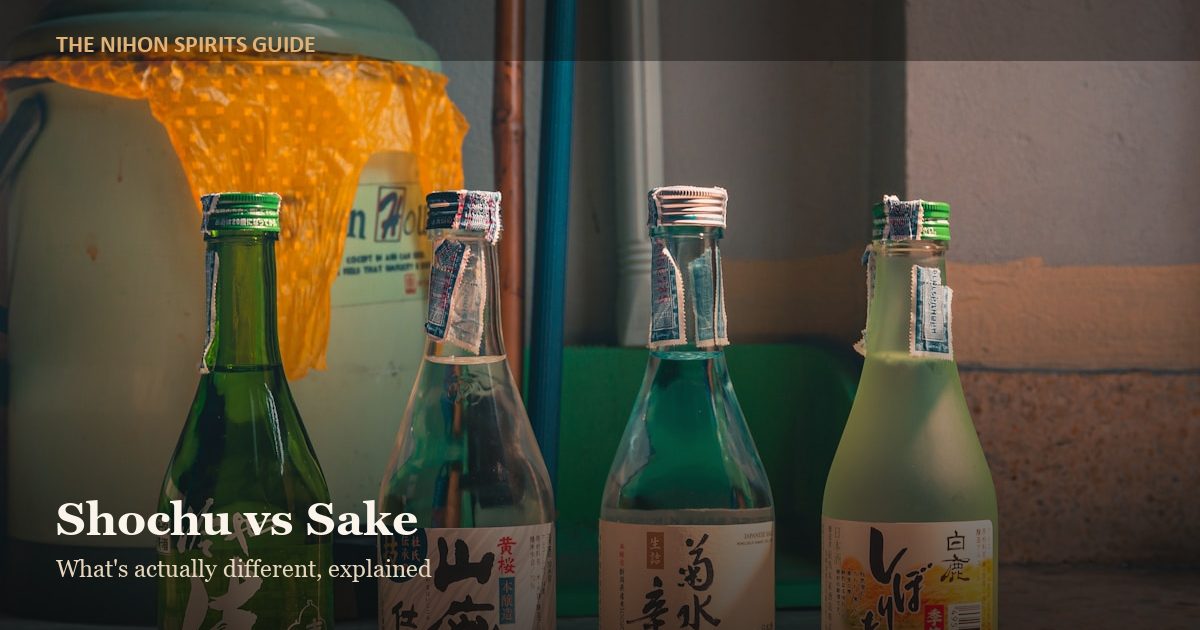
Quick answer: sake is brewed, shochu is distilled, and that one difference explains almost everything else. Sake ferments rice into an alcoholic liquid the way wine or beer does, landing around 15-16% ABV. Shochu takes a fermented base, usually barley, sweet potato, or rice, and distills it the way vodka or whisky is made, landing anywhere from 25% up to a legal ceiling of 45%. They’re both Japanese, both often mistaken for each other by newcomers, and both regulated by the same industry body, but they’re not two versions of the same drink. They’re closer to comparing wine to gin.
Shochu vs Sake: Comparison at a Glance
| Sake | Shochu | |
|---|---|---|
| Production method | Brewed (fermentation only) | Distilled (fermented, then distilled) |
| Typical ABV | 15-16% | 25% typical; legal ceiling 45% (honkaku/otsurui) or 36% (korui) |
| Base ingredient | Rice, koji, water, yeast | Barley, sweet potato, rice, buckwheat, or sugarcane |
| Closest Western parallel | Wine or beer | Vodka, whisky, or a rustic eau-de-vie |
| How it’s usually served | Chilled or warmed, straight | On the rocks, with hot water (oyu-wari), with cold water (mizu-wari), or with soda |
| Regulatory body | Japan Sake and Shochu Makers Association (JSS) | Same association (JSS) |
The Core Difference: Brewed vs Distilled
Sake is a brewed beverage. Rice starch is converted to sugar by koji mold, then fermented by yeast into alcohol, a parallel process unique to sake production but fundamentally the same category of process that makes wine and beer: fermentation, and nothing else, sets the final alcohol content. That caps sake naturally around 15-16% ABV, since yeast can’t survive much past that concentration.
Shochu starts with a similar fermented base, but then goes through a still. Distillation separates alcohol from the fermented liquid by heat, concentrating it well past what fermentation alone can produce. That’s the same basic principle behind whisky, vodka, and brandy, applied to Japanese ingredients and technique. It’s why shochu can legally reach 45% ABV while sake physically cannot.
What Shochu Is Actually Made From
Unlike sake, which is rice or nothing, shochu is defined by its base ingredient more than any single grain. The most common types sold internationally:
- Mugi shochu (barley): the most export-friendly style, generally lighter and easier to drink neat or on the rocks for someone new to the category
- Imo shochu (sweet potato): earthier and more aromatic, with a distinct sweet-potato character that’s polarizing for newcomers but has a dedicated following
- Kome shochu (rice): the closest in raw material to sake, but distilled, giving a cleaner, softer profile than barley or sweet potato versions
- Soba shochu (buckwheat) and kokutou shochu (brown sugar, made almost exclusively in Okinawa) are less common outside Japan but worth knowing if you see them on a menu
Sake has nothing equivalent to this ingredient split. Every sake starts from rice; the variation comes from polishing ratio and brewing method instead, the distinction covered in our sake grades guide.
Honkaku Shochu vs Korui Shochu: The Distinction That Actually Matters
Not all shochu is built the same way, and this is the split that matters more than the base ingredient for anyone trying to understand quality. Japan’s Liquor Tax Act splits shochu into two broad categories based on how it’s distilled:
- Honkaku shochu (single distillation, sometimes labeled otsurui): distilled once in a pot still, which keeps much of the base ingredient’s character in the final spirit. Capped at 45% ABV by law. This is the category worth seeking out if you want to actually taste the difference between a barley shochu and a sweet-potato shochu.
- Korui shochu (continuous, multi-column distillation): distilled repeatedly until it’s nearly neutral, similar in spirit to how vodka is made. Capped at 36% ABV. This is the base spirit used in most canned chuhai (shochu-based sour cocktails) sold in convenience stores, where a clean, characterless base is the point rather than a flaw.
If a bottle doesn’t say “honkaku” anywhere on the label, it’s worth checking which category it falls into before assuming it will taste like the barley or sweet-potato shochu described in a review. A korui base spirit and a honkaku barley shochu can both legally be called shochu while tasting almost nothing alike.
Shochu vs Soju: Not the Same Drink, Despite the Confusion
Shochu is frequently confused with Korean soju, and the confusion runs both directions in casual conversation. Soju is Korea’s equivalent distilled spirit, and the two categories share a common distillation heritage, but mass-market soju sold today is typically distilled from a neutral base (often sweet potato or grain) and diluted down to around 16-20% ABV, closer to sake’s strength than to shochu’s. Honkaku shochu, by contrast, is usually bottled at 25% or higher and built specifically to showcase the base ingredient rather than stay neutral. If a menu or a bottle says “soju,” it’s a different country’s product with a different typical strength and a different flavor goal, not a regional name for shochu.
How Each One Is Actually Served
Sake’s serving temperature is a genuine variable, covered in depth in our other guides: chilled for aromatic Ginjo and Daiginjo styles, warmed for fuller-bodied Junmai and Honjozo. Shochu’s serving question is different, because at 25-45% ABV, most people don’t drink it straight the way they might sip a sake.
The standard shochu serves are:
- On the rocks (rock): the most common way to drink honkaku shochu when you want to actually taste it, since ice dilutes it gradually rather than all at once
- Oyu-wari (with hot water): mixed roughly half-and-half with hot water, which opens up aroma more than cold dilution does; especially common with imo shochu in winter
- Mizu-wari (with cold water): the same idea served cold, common in summer
- Soda or chuhai-style: mixed with soda water and often citrus, the format most canned convenience-store products are built around, usually using korui shochu as the base
Sake generally isn’t diluted this way; shochu, at roughly double sake’s strength, is built around dilution as a normal part of drinking it, not a compromise.
Shochu vs Sake: Which Should You Try First?
- Want something closer to wine, meant to be sipped on its own: sake. Start with a Junmai Ginjo if you want aromatic and fruity, or a Junmai if you want something fuller and food-friendly.
- Want a spirit you can mix, similar to how you’d use vodka or a light whisky: mugi (barley) shochu on the rocks or with soda is the most approachable entry point.
- Curious about the most distinctive, least Western-parallel option: imo (sweet potato) shochu, ideally oyu-wari with hot water, is the style with the least resemblance to anything outside Japan.
- Ordering at a Japanese restaurant and want to pair with food: sake generally pairs more predictably with a full meal; shochu is more commonly drunk on its own or alongside grilled, salty izakaya food rather than a formal dinner.
FAQ
Is shochu stronger than sake?
Yes, substantially. Sake tops out around 15-16% ABV because fermentation alone can’t push higher. Shochu is distilled, so it typically starts around 25% and can legally reach 45% for honkaku styles, roughly double to triple sake’s strength.
Is shochu the same as sake, just stronger?
No. They’re made by entirely different processes (brewing vs distilling) from different base ingredients in most cases (rice-only for sake, barley/sweet potato/rice/buckwheat for shochu). Strength is one difference among several, not the defining one.
Is shochu similar to vodka?
Korui (continuous-distillation) shochu is genuinely close to vodka in character, nearly neutral and built for mixing. Honkaku (single-distillation) shochu is closer to a rustic, ingredient-driven spirit like a barley or potato eau-de-vie, since the point of honkaku production is preserving flavor from the base ingredient rather than stripping it out.
Can I substitute shochu for sake in a recipe, or the other way around?
Not directly. Cooking sake and shochu serve different roles: sake contributes sweetness and umami at a modest ABV, while shochu’s higher proof and more neutral-to-distinctive flavor (depending on type) behaves more like a cooking spirit than a cooking wine. If a recipe specifically calls for one, substituting the other will change both the flavor and the alcohol content of the dish.
What is shochu vs awamori?
Awamori is a related but distinct Okinawan spirit, distilled from Thai long-grain rice using black koji, a different lineage from mainland Japanese shochu’s koji strains and base ingredients. It’s sometimes grouped with shochu casually, but it’s regulated and produced as its own category.
Final Thoughts
Shochu and sake get lumped together mostly because they’re both Japanese and both unfamiliar to a lot of drinkers outside Japan at the same time. Once you know one is brewed and one is distilled, most of the rest of the confusion resolves itself: why shochu is stronger, why it’s usually diluted and sake usually isn’t, and why “which one is better” is roughly as useful a question as asking whether wine is better than gin. If you’re new to both, sake is the gentler, more wine-like starting point; shochu, particularly a barley (mugi) style on the rocks, is the more approachable entry into the distilled side. For where sake’s own internal grades fit once you’ve settled on brewed over distilled, see our sake grades explained guide.