

As an Amazon Associate, we earn from qualifying purchases. This doesn’t affect the price you pay or which picks we recommend.
Quick answer: the tapered, double-cone “Japanese-style” jigger, two cones joined tip-to-tip with different capacities on each end, gives you the most precise, easy-to-read pour, and it’s what most bars actually use. The double-cup OXO-style jigger, two separate cups joined base-to-base, is easier to set down without spilling and remains the best-selling shot-measuring tool on Amazon by a wide margin, but it’s a genuinely different design with different tradeoffs, not just a cheaper copy.
Two Shapes, Not One “Right” Jigger
The tapered double-cone jigger shape, narrow in the middle, wider at both ends, is the design most associated with Japanese bartending, refined for precise, controlled pours where the bartender reads the fill line against the taper rather than a printed measurement. Most of what’s sold under “Japanese style” on Amazon is this shape, made by Western barware brands rather than Japanese manufacturers; the design lineage is genuinely Japanese even when the specific product isn’t. The OXO-style double jigger uses two straight-walled cups joined at their bases instead, a different, non-Japanese design that trades some of the tapered jigger’s pour precision for a shape that sits flat and doesn’t roll off a bar mat.
Jiggers: Comparison at a Glance
| Jigger | Shape | Measurements | Best For |
|---|---|---|---|
| A Bar Above Jigger | Japanese-style tapered | 10 marked measurements | Most versatile marked pours |
| Barfly M37005 | Japanese-style tapered | 1 oz & 2 oz | The classic standard-pour size |
| Barfly M37000 | Japanese-style tapered | 1/2 oz & 3/4 oz | Smaller, precision pours |
| OXO Steel Double Jigger | Straight double-cup | 1 oz & 1.5 oz | Stability and easy cleanup |
Prices vary by retailer and change often — treat these as a starting point, not a quote.
1. A Bar Above Jigger — Most Versatile Marked Pours
This tapered jigger etches ten separate measurement lines inside the cone (quarter-ounce increments across both the large and small ends), which is the main reason it’s one of the best-reviewed bar jiggers on Amazon. For a home bar mixing more than one or two standard cocktail recipes, that range of marked pours matters more than it sounds: most other jiggers only give you the two end capacities, with nothing in between.
Pros:
- Ten marked measurements instead of just two end capacities
- The tapered shape reads accurately at a glance once you’re used to it
Cons:
- Not made by a Japanese company; “Japanese style” describes the tapered shape, not the manufacturer
- The narrow middle section is easier to tip over than a flat-bottomed design
Bottom line: the pick if you want one jigger that covers the widest range of pour sizes.

A Bar Above Japanese-Style Jigger
10 marked measurements, stainless steel. 4.8★ (2,434 ratings).
2. Barfly M37005 — The Classic 1 oz / 2 oz Standard
This is the plain, classic tapered jigger shape at the two capacities most cocktail recipes actually call for: 1 ounce on the small end, 2 ounces on the large end. No extra marked lines, no branding flourishes, just the standard Japanese-style shape at the sizes you’ll use most often.
Pros:
- Covers the two most commonly used pour sizes without extra features to fumble with
- The simplest, least expensive way to get the tapered shape
Cons:
- No intermediate markings if a recipe calls for something between 1 and 2 ounces
- Same tip-over risk as any tapered jigger on a crowded bar cart
Bottom line: the pick if you want the classic shape at the sizes you’ll actually use most.

Barfly M37005 Jigger, 1oz x 2oz
Japanese-style shape, stainless steel. 4.8★ (1,741 ratings).
3. Barfly M37000 — Smaller, Precision Pours
The same tapered shape as the M37005, scaled down to 1/2 ounce and 3/4 ounce ends. That range matters for cocktails built around smaller measured additions, bitters aside, things like a dash of amaro or a modifier you don’t want to overpour, rather than the full spirit base.
Pros:
- Sized specifically for the smaller measurements a full 1 oz/2 oz jigger handles poorly
- Same reliable tapered shape and read-by-fill-line accuracy
Cons:
- Not a replacement for a standard-size jigger; you’ll likely want both if you make a range of cocktails
Bottom line: the pick as a second jigger once your standard-size one doesn’t cover small enough pours.

Barfly M37000 Jigger, 1/2oz x 3/4oz
Smaller pour sizes, stainless steel. 4.8★ (1,741 ratings).
4. OXO Steel Double Jigger — Stability Over Precision
OXO’s double jigger swaps the tapered cone for two straight-walled cups joined base to base, at 1 ounce and 1.5 ounces. It’s the best-selling jigger in this category on Amazon by a wide margin, and the flat-bottomed cups are genuinely easier to set upright on a counter between pours than a tapered jigger, which tends to roll.
Pros:
- Sits flat and stable between pours, unlike a tapered jigger
- Straightforward two-capacity design with no learning curve
Cons:
- No intermediate markings, and the straight-walled cup is harder to read a partial pour against than a tapered cone
- Not the shape professional bartenders trained on Japanese-style pouring technique will find familiar
Bottom line: the pick if you’d rather have a jigger that won’t roll off the counter than one built for precise partial pours.
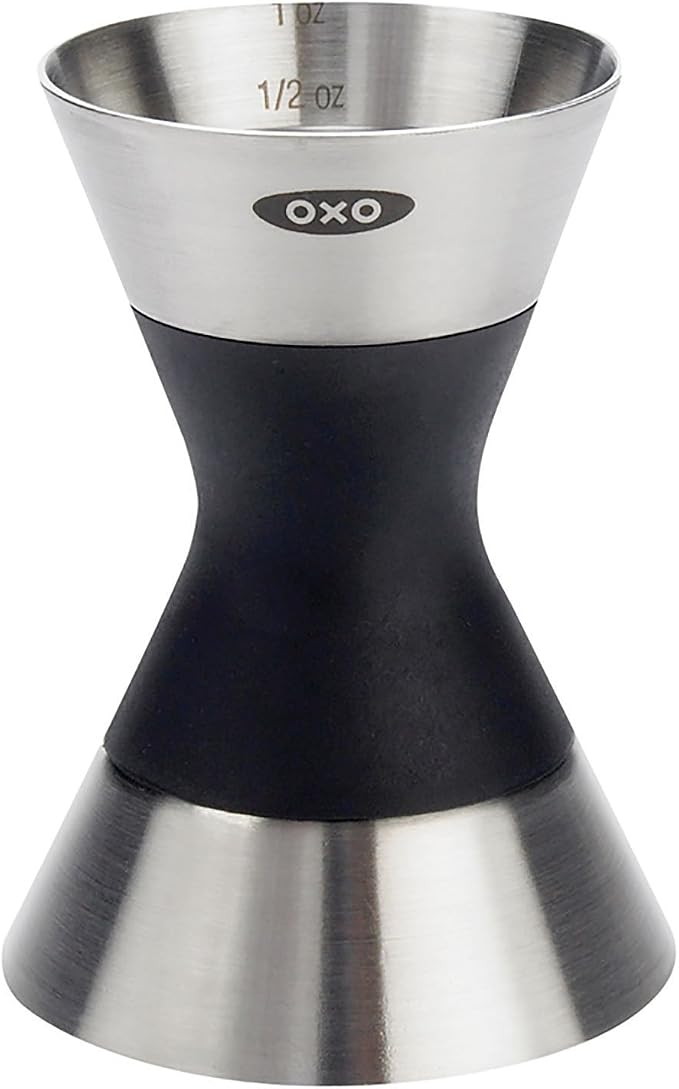
OXO Steel Double Jigger
Won’t roll off the counter. 4.8★ (15,317 ratings).
FAQ
What makes a jigger “Japanese style”?
The tapered, double-cone shape, two cones joined tip-to-tip with different capacities on each end, is the design most associated with Japanese bartending. Most jiggers sold under that name are made by Western barware brands, not Japanese companies; the phrase describes the shape, not the manufacturer.
Is the tapered jigger actually more accurate than a double-cup jigger?
Once you’re used to reading the fill line against the taper, yes, it’s generally considered more precise, especially for partial pours between the two marked capacities. A straight-walled double-cup jigger is easier to read at a glance for its two set capacities but doesn’t handle in-between measurements as well.
Do I need more than one jigger?
If you make a range of cocktails, a standard 1 oz/2 oz jigger plus a smaller 1/2 oz/3/4 oz jigger covers most recipes without constant re-pouring or estimating.
What should I actually measure into one of these?
A Japanese highball is the simplest place to start; see our Real Japanese Whisky complete list for bottles that work well in one, or pair your jigger with our genuine Japanese bar spoon guide for the rest of a stirred cocktail setup.
Final Thoughts
Neither jigger shape is objectively better; they’re built for different priorities. The tapered Japanese-style jigger rewards precision once you’re comfortable reading it, while the OXO-style double-cup jigger trades some of that precision for a shape that’s harder to knock over. If owning something Japanese-made specifically matters to you the way it does with our bar spoon guide, know going in that none of the jiggers here are made by a Japanese company, only the design is. Once your bar tools are sorted, our Hakushu 12 and Yamazaki 12 reviews are a good place to start deciding what to actually pour with them.
