
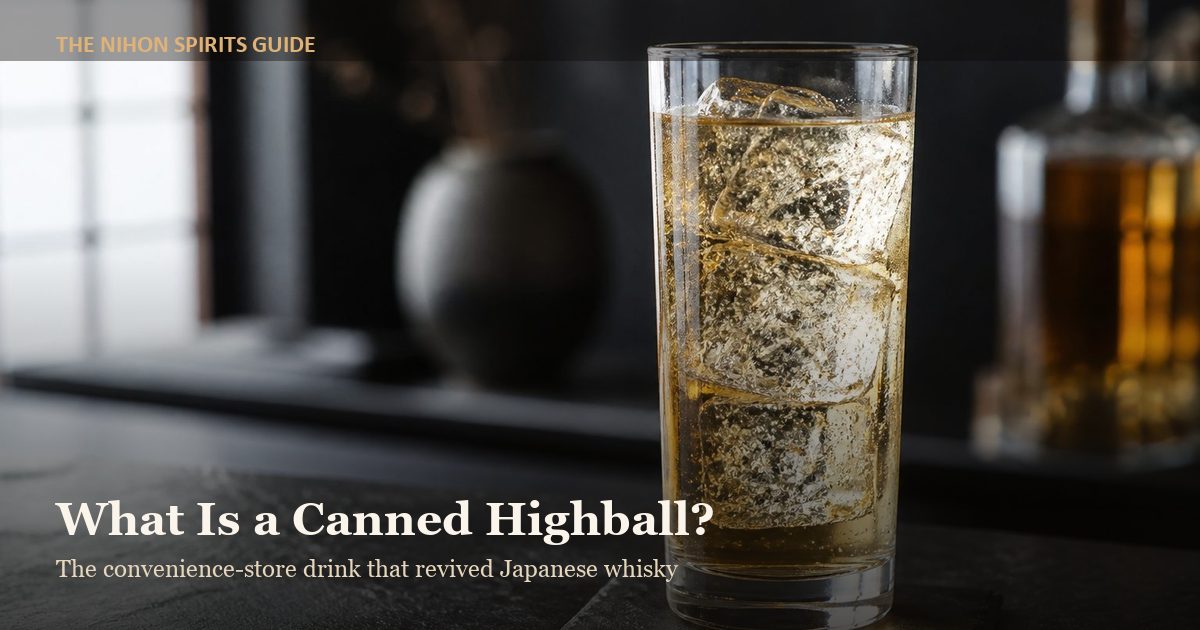
Quick answer: a Japanese canned highball is whisky, soda water, and usually a hit of lemon, pre-mixed and carbonated in a can — the convenience-store version of the drink that revived Suntory’s whisky business in the late 2000s. You can technically find imported cans in the US through small Japanese grocery importers and resale marketplaces, but stock is inconsistent and a can that’s spent weeks in transit rarely tastes like one bought cold from a Tokyo konbini. The more reliable move is building the same drink at home with a bottle you can actually buy consistently.
Some of the retailers we link to are partners who may pay us when you buy through them. This doesn’t change which bottles we recommend. How this works.
What’s Actually in the Can
A canned highball is whisky pre-mixed with carbonated water at roughly the same ratio a bartender would build by hand — Suntory’s standard cans run about 7% ABV, with “strong” variants closer to 9%, compared to the 43–45% ABV of the whisky itself before dilution. Most are flavored with a small amount of lemon, either as a subtle background note or, in lemon-forward versions, a much more pronounced citrus hit. They’re sold in 350ml and 500ml cans, built to be drunk cold and straight from the can rather than poured over ice, which is the main practical difference from making one yourself at home.
How the Canned Highball Took Over Japan
The canned highball’s ubiquity in Japan traces back to a specific marketing problem. By the mid-2000s, Japan’s whisky market had been shrinking for roughly a quarter century, and Suntory’s research pointed to a generational shift: younger drinkers saw whisky as strong, old-fashioned, and a poor match for food. Starting around 2007–2008, Suntory repositioned its flagship Kakubin blend around the highball specifically — low-alcohol, food-friendly, and easy to drink — fronted by actress and model Koyuki rather than the older, more masculine whisky advertising that came before it.
The campaign is widely credited with a real turnaround: reporting on the period describes Kakubin sales climbing roughly 70% and the number of izakaya offering highballs on their menu growing from around 15,000 to 40,000 in the campaign’s first two years. Suntory sold canned versions of the drink alongside the bar campaign from the start, and the lineup has expanded considerably since — convenience store coolers in Japan now stock well over a dozen variants, including limited-run cans built around specific single malts like Hakushu, released to mark anniversaries or seasons.
Can You Actually Buy Them in the US?
Inconsistently. Suntory’s canned highball lineup is built for the Japanese domestic market, not for export, so there’s no reliable US retail channel the way there is for the bottled whisky itself. What you’ll find instead is a patchwork of small Japanese grocery importers and resale listings on sites like eBay, both with stock that comes and goes and pricing that swings widely between sellers for the same can.
There’s also a real quality problem that doesn’t apply to the bottled whisky: a canned highball is a finished, carbonated drink, not a spirit that holds up indefinitely in a warehouse. A can that’s spent weeks or months in transit and storage before reaching a US shelf is a worse version of the drink than one bought cold in Japan, even if the label and ABV are identical. That’s a meaningful difference from importing a bottle of Toki or Kakubin, where the product itself doesn’t degrade the same way in transit.
The Better Move: Build the Same Drink With What You Can Actually Buy
Given the import problems, the more reliable way to get the actual drink is to make it yourself with a bottle that’s consistently available in US stores. Our guide to the best Japanese whisky for highballs covers which bottles actually hold up at highball dilution and why (short version: Suntory Toki was built specifically for this drink and costs less than Kakubin in most US stores, despite Kakubin being the more traditional choice in Japan). Per Suntory’s own published ratio, that’s 3–4 parts chilled soda water to 1 part whisky, built over ice and stirred once rather than swirled — close enough to the can’s own ratio that the homemade version reads as the same drink, just fresher. The right glass matters more than it sounds like it should here too, since a thin-walled glass keeps the drink colder and preserves carbonation longer than a standard rocks glass.
Shop at The Whisky Exchange: Suntory Toki →
FAQ
What’s the ABV of a canned Japanese highball?
Typically around 7% for standard cans and closer to 9% for “strong” variants, compared to 43–45% for the whisky itself before it’s diluted with soda water.
Is the canned version the same recipe as a bar-made highball?
Close to it. Canned highballs are built around the same basic ratio bartenders use, pre-mixed and carbonated for convenience rather than made to order, though bar or homemade versions let you control freshness and ratio more precisely.
Does Suntory sell canned highballs in the US?
Not through a consistent mainstream retail channel. The lineup is built for the Japanese domestic market; what reaches the US comes through small importers and resale listings, with stock and pricing that vary considerably.
Why did highballs become so popular in Japan in the first place?
A Suntory marketing campaign starting around 2007–2008 repositioned whisky as a low-alcohol, food-friendly drink for a younger generation that had been avoiding it, built around the flagship Kakubin blend. It’s widely credited with reversing roughly 25 years of declining whisky sales in Japan.
Can I just buy a can on eBay?
You can find listings, but treat pricing and freshness as unpredictable. A carbonated, pre-mixed drink that’s spent an unknown amount of time in transit and storage is a different experience from one bought cold in Japan, in a way that doesn’t apply to importing a sealed bottle of whisky.
Final Thoughts
The canned highball is a real and specific product of Japan’s convenience-store drinking culture, not just a marketing gimmick, and the history behind it (a whisky market in real decline, rescued largely by repositioning one blend as a casual, food-friendly drink) is more interesting than the can itself. But chasing an imported can to the US mostly means paying gray-market prices for a worse version of a drink that’s easy to build fresh at home. Our guide to the best Japanese whisky for highballs covers exactly which bottle to start with.