
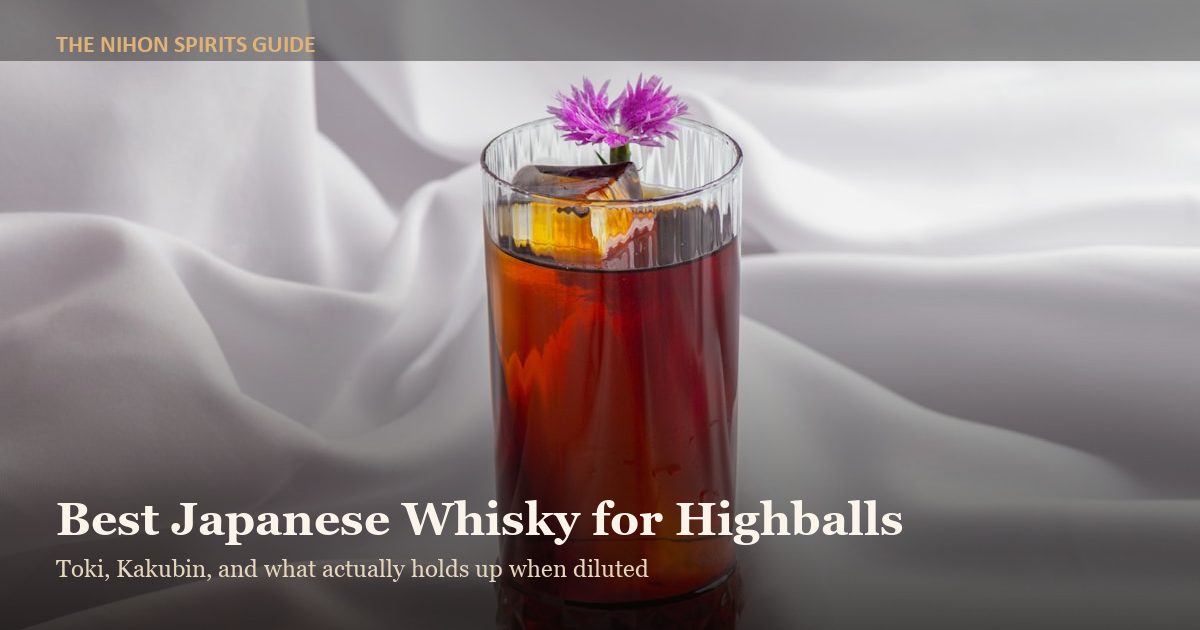
Quick answer: Suntory Toki was engineered by Suntory’s own chief blender specifically to be mixed with soda, and at $32–$39 a bottle in the US, it’s also the cheapest of the three whiskies most commonly recommended for a Japanese highball. Suntory Kakubin is the more traditional, more Japan-authentic pick, but ironically costs more in most US stores than Toki does. Nikka Coffey Grain is the sweeter, dessert-leaning option if you want something closer to cream soda than to whisky.
Why Some Whisky Works Better in a Highball Than Others
A highball is mostly dilution: Suntory’s own published recipe for the Toki Highball calls for 3–4 parts soda water to 1 part whisky, which means a standard pour is roughly 80% soda by volume. A whisky built around subtle, delicate flavors can vanish entirely at that ratio. The whiskies that hold up best tend to have either a bright, structured top note (citrus, green apple, pepper) that cuts through the dilution, or enough natural sweetness that it reads clearly even at 20% of the glass. That’s a different set of priorities than what makes a whisky good to sip neat, which is why “best for highballs” and “best overall” aren’t the same list.
Comparison at a Glance
| Whisky | Style | How It Reads in a Highball | US Price (750ml) | JSLMA Status |
|---|---|---|---|---|
| Suntory Toki | Blended (grain + malt, 3 distilleries) | Green apple, ginger, light pepper finish; built for this exact drink | $32–$39 | Compliant (verified in our Is Suntory Toki Actually Real Japanese Whisky? deep dive) |
| Suntory Kakubin | Blended (Suntory’s flagship domestic label since 1937) | Dry, cereal-forward, cuts through fried food; the “default” Japan pours | $75–$85 average | Compliant |
| Nikka Coffey Grain | Single grain, corn-based, continuous Coffey still | Vanilla, coconut, mango; reads like a lighter cream soda | $65–$80 | Compliant |
Prices checked against US retailer listings (Total Wine, ABC Fine Wine & Spirits, Binny’s) on August 29, 2026; actual shelf price varies by state and store.
Suntory Toki
Toki is a blend of whiskies from Suntory’s Hakushu, Yamazaki, and Chita distilleries, and unlike most blended whisky, it wasn’t designed primarily to be sipped neat. Suntory has been explicit that Toki was built around the highball specifically, and the flavor profile backs that up: green apple and basil up front, a peppery, gingery finish that stays present even heavily diluted. We verified separately that Toki meets the JSLMA standard for genuine Japanese whisky, so the “built in Japan” claim on the label holds up.
Pros:
- Purpose-built for the highball, not a repurposed sipping whisky
- The cheapest of the three picks here at typical US retail
- JSLMA-compliant, confirmed independently
Cons:
- Its lighter profile means it can read as thin if you go past a 1:3 ratio
- Less complexity than Kakubin if you’re drinking it slowly over ice with minimal soda
Bottom line: the pick if you want the highball the whisky was actually designed for, at the lowest price of the three. Shop it at The Whisky Exchange →
Suntory Kakubin
Kakubin (“square bottle”) is Suntory’s oldest continuously sold blend and the whisky most associated with the highball’s popularity in Japan in the first place; it’s the pour behind the counter at most izakaya and yakitori spots specifically because its dry, cereal-forward profile cuts through fried and grilled food. That authenticity comes at an odd cost outside Japan: Kakubin runs about ¥1,910 (roughly $12) per 700ml bottle in Japan, but US retailers price it at $75–$85 for the equivalent size, a markup driven by import and distribution costs rather than anything about the whisky itself.
Pros:
- The most historically and culturally “correct” highball whisky on this list
- Dry, savory profile pairs specifically well with food
- JSLMA-compliant, long-established domestic Japanese product
Cons:
- Priced roughly double Toki in most US stores for a whisky built for the same job
- Rougher, punchier profile than Toki if you’re new to Japanese whisky
Bottom line: worth the premium only if the “what locals actually drink” authenticity matters more to you than value. Out of stock at The Whisky Exchange when we checked on September 29, 2026.
Nikka Coffey Grain
We’ve reviewed Nikka Coffey Grain in full separately, and its profile makes it the outlier pick here: made primarily from corn in a continuous Coffey still, it leans sweet, with vanilla, coconut, and mango notes that read almost like a dessert cocktail once soda is added, closer to cream soda than to a traditional dry highball.
Pros:
- Distinct sweeter profile if Toki or Kakubin’s dryness isn’t what you want
- Interesting on its own terms, not just a highball whisky (see our full review)
- JSLMA-compliant
Cons:
- Priced closer to Kakubin than to Toki, without Kakubin’s cultural pedigree
- Sweetness can feel one-note if you’re expecting a classic dry highball
Bottom line: the pick if you want your highball to taste more like dessert than like a bar order. Shop it at The Whisky Exchange →
How to Actually Build One
Per Suntory’s own published recipe for the Toki Highball: fill a tall glass with ice and let it chill, pour the whisky over the ice and give it a single stir, then add chilled soda water at a 3–4 parts soda to 1 part whisky ratio (roughly 45ml whisky to 135–180ml soda for a standard pour). Stir once, bottom to top, with a bar spoon rather than swirling, to avoid killing the carbonation. The right glass matters more than most people assume here: we cover why in our guide to real Japanese highball glasses, and a proper bar spoon and jigger make the ratio easy to hit consistently rather than eyeballing it.
Want the same whisky without the carbonation? Our guide to mizuwari vs highball covers the still-water version of this drink, which was actually Japan’s standard way of serving whisky before the highball boom.
The Kakubin Version: Suntory’s 1:4 Kaku-Highball
If you are building the drink with Kakubin rather than Toki, Suntory’s official Kakubin page uses a slightly longer ratio: a small squeeze of lemon, a glass full of ice, Kakubin and soda at 1:4, poured gently so the carbonation holds. This is the kaku-highball served in most Japanese izakaya, and it is the drink behind Japan’s modern highball boom: Suntory started promoting it in 2008, and Metropolis reported in 2009 that it had spread from about 5,000 pubs to 50,000 establishments in roughly a year.
Which One Should You Buy?
- You want the whisky actually designed for this drink, at the lowest price: Suntory Toki.
- You want what’s actually behind the bar in Japan, and don’t mind paying a real premium for it outside Japan: Suntory Kakubin.
- You want something sweeter, closer to a dessert cocktail than a dry highball: Nikka Coffey Grain.
FAQ
Is Suntory Toki actually made for highballs, or is that just marketing?
It’s a real design choice, not just a slogan. Suntory’s chief blender has spoken publicly about building Toki’s flavor profile around dilution with soda, and the whisky’s bright, structured top notes are consistent with that goal rather than with a whisky meant to be sipped neat.
Why does Kakubin cost so much more in the US than in Japan?
Import duties, distribution markups, and limited US allocation all add cost between the ¥1,910 Japan shelf price and the $75–$85 typical US price. It isn’t a different or more premium product; it’s the same whisky with a longer supply chain behind it.
What’s the correct whisky-to-soda ratio for a Japanese highball?
Suntory’s own published recipe calls for 3 to 4 parts soda to 1 part whisky, roughly 45ml of whisky to 135–180ml of soda for a standard pour, built over ice and stirred once rather than swirled.
Can I use any Japanese whisky for a highball?
Technically yes, but pricier sipping whiskies like Hibiki or Yamazaki single malt are generally a waste of their own complexity when diluted 4-to-1 with soda; that structure and nuance is exactly what gets lost. Whiskies built or chosen specifically for mixing hold up better and cost less.
Does the type of soda water matter?
Suntory’s own materials emphasize using a plain, high-carbonation soda water and keeping it well chilled, rather than a flavored or lower-carbonation mixer, since the point is to extend the whisky’s flavor without masking it.
What about the canned Japanese highball you can buy in Japan?
That’s a pre-mixed, carbonated version of this same drink, built for convenience stores rather than home bars. Our guide to the Japanese canned highball covers its history and why importing the actual can to the US usually isn’t worth it compared to building one fresh with a bottle from this list.
Final Thoughts
If you’re deciding between these three on value alone, Toki wins outright: it costs less than the other two and was the one actually designed for this job. Kakubin is worth the premium specifically if “what people in Japan are actually drinking” matters to you, and Nikka Coffey Grain is worth trying if you want the highball to lean sweet rather than dry. Whichever bottle you land on, see our guide to Japanese highball glasses for the other half of getting this drink right.