
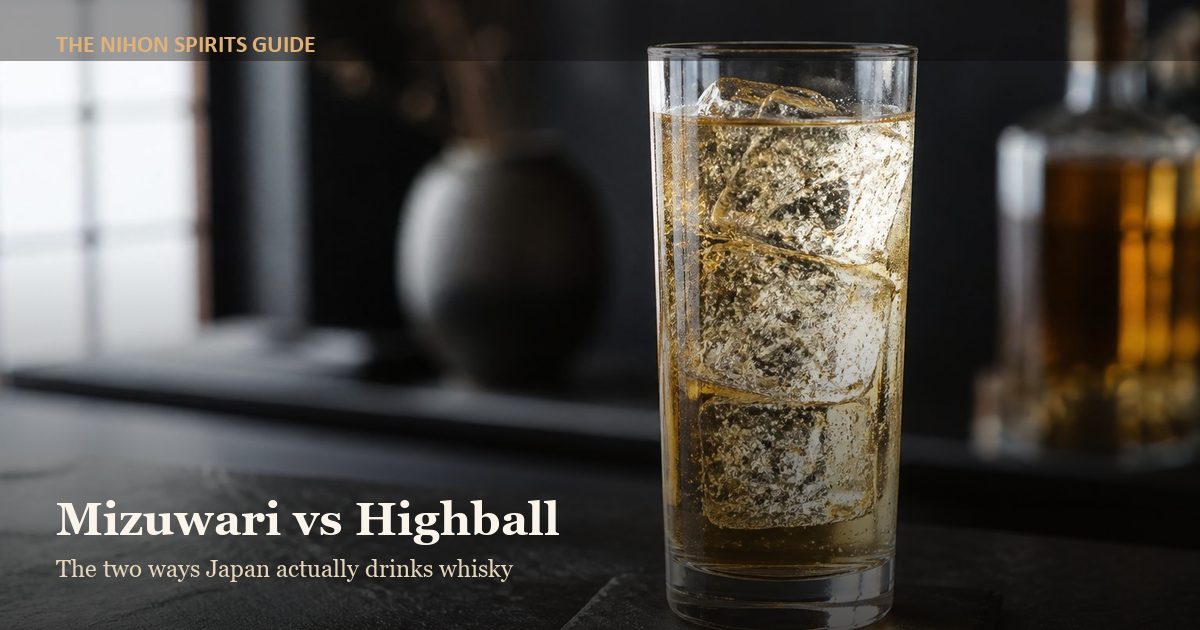
Quick answer: a highball mixes whisky with carbonated soda water; a mizuwari mixes it with still, uncarbonated water instead, usually at a stronger ratio of about 1 part whisky to 2 parts water rather than the highball’s 1-to-3-or-4. The highball is the louder, more casual izakaya order; mizuwari is the quieter, more deliberate one, and it was actually the dominant way Japan drank whisky before the highball’s marketing-driven boom in the late 2000s.
Some of the retailers we link to are partners who may pay us when you buy through them. This doesn’t change which bottles we recommend. How this works.
The Actual Difference: Carbonation, Not Just Ratio
Both drinks are whisky diluted with water and served over ice, which is why they get confused, but the water itself isn’t the same. A highball uses soda water, and the carbonation is the point — it lifts the whisky’s aromatics and gives the drink a lighter, brighter character even at a heavy dilution. A mizuwari uses plain, still water, usually mineral or filtered rather than tap, and the result reads as smoother and rounder rather than sparkling. Our guide to Japanese whisky for highballs covers the soda-based drink and which bottles hold up in it; this one is about the still-water version.
The ratio differs too. Suntory’s own published highball recipe calls for 3 to 4 parts soda to 1 part whisky, close to 80% dilution. Mizuwari is typically built stronger, closer to 2 parts water to 1 part whisky, since there’s no carbonation lifting the aromatics the way soda does, and the drink is meant to be sipped slowly rather than gulped alongside food the way a highball often is.
Where Mizuwari Actually Comes From
Mizuwari (水割り, literally “cut with water”) predates the modern whisky highball by decades, and its roots are in shochu, not whisky — diluting a stronger spirit with water to make it easier to drink through a meal or a long evening is a much older Japanese drinking habit that whisky was folded into later. Before Suntory’s highball marketing campaign took off in the late 2000s and rebuilt Kakubin’s sales around soda water, mizuwari was the standard way whisky was served in Japanese bars, including in the hostess-club and business-entertaining scene where a slower, quieter drink suited the setting better than something as casual as a highball. Our guide to the Japanese canned highball covers that later boom in more detail.
Which Whisky Actually Works in a Mizuwari
The same logic that makes a whisky good in a highball mostly holds here, with one difference: without carbonation lifting bright top notes, a whisky with real underlying character reads more clearly in a mizuwari than in a highball, since there’s less going on around it to compete with. Suntory Kakubin‘s dry, cereal-forward profile, the style most associated with mizuwari historically, holds up well at the stronger ratio. Lighter blends built specifically for highballs, like Suntory Toki, can read as a little thin without the soda doing some of the work, though they’re still perfectly drinkable this way.
How to Actually Build One
Fill a tall glass with ice first and let it chill briefly, the same starting point as a highball. Pour the whisky over the ice, then add still water at roughly a 2-to-1 ratio of water to whisky — for a standard 45ml pour of whisky, that’s about 90ml of water, though this is a matter of personal taste more than a fixed rule the way a highball’s soda ratio is. Stir gently rather than swirling, enough to mix without deliberately trying to kill the fizz the way you would with a highball, since there’s no carbonation here to protect in the first place. Use filtered or mineral water rather than tap water if you want it closer to how it’s typically served in Japan; the point of the drink is a clean, neutral dilution, and tap water’s own flavor can interfere with that more than it would in a soda-based drink. A proper jigger makes the ratio easy to repeat rather than eyeballing it each time.
Shop at The Whisky Exchange: Suntory Toki →
FAQ
Is mizuwari just a highball without the bubbles?
Close, but the ratio is different too. A mizuwari is built stronger, around 2 parts water to 1 part whisky, compared to a highball’s 3-to-4-parts soda. The combination of no carbonation and a stronger pour is what gives it a rounder, quieter character than a highball.
Which came first, mizuwari or the highball?
Mizuwari, by a wide margin. It has roots in older Japanese shochu-drinking habits and was the standard way whisky was served in Japan before a Suntory marketing campaign in the late 2000s built the modern highball boom around Kakubin specifically.
What kind of water should I use?
Still, not sparkling — filtered or mineral water is closer to how it’s typically served in Japan than tap water, since the drink is meant to be a clean, neutral dilution rather than one where the water itself adds flavor.
Does mizuwari work with any Japanese whisky?
Whiskies with real underlying character read more clearly in a mizuwari than in a highball, since there’s no carbonation competing for attention. Dry, traditional blends like Kakubin are the historical pairing, though lighter blends built specifically for highballs work here too, just with a bit less presence.
Is one drink more “authentic” than the other?
Both are genuinely Japanese drinking traditions, just from different eras and settings — mizuwari from older shochu-influenced bar culture, the highball from a specific, well-documented 2000s marketing push. Neither is a Western import or a gimmick.
Final Thoughts
The highball gets most of the attention outside Japan because it’s the one with the marketing history and the canned convenience-store version, but mizuwari is the older, quieter drink it grew out of, and it’s worth trying specifically because it shows a different side of the same whisky. Start with Kakubin if you want the traditional pairing, and see our guide to whisky for highballs for the soda-based version once you’ve compared the two side by side.