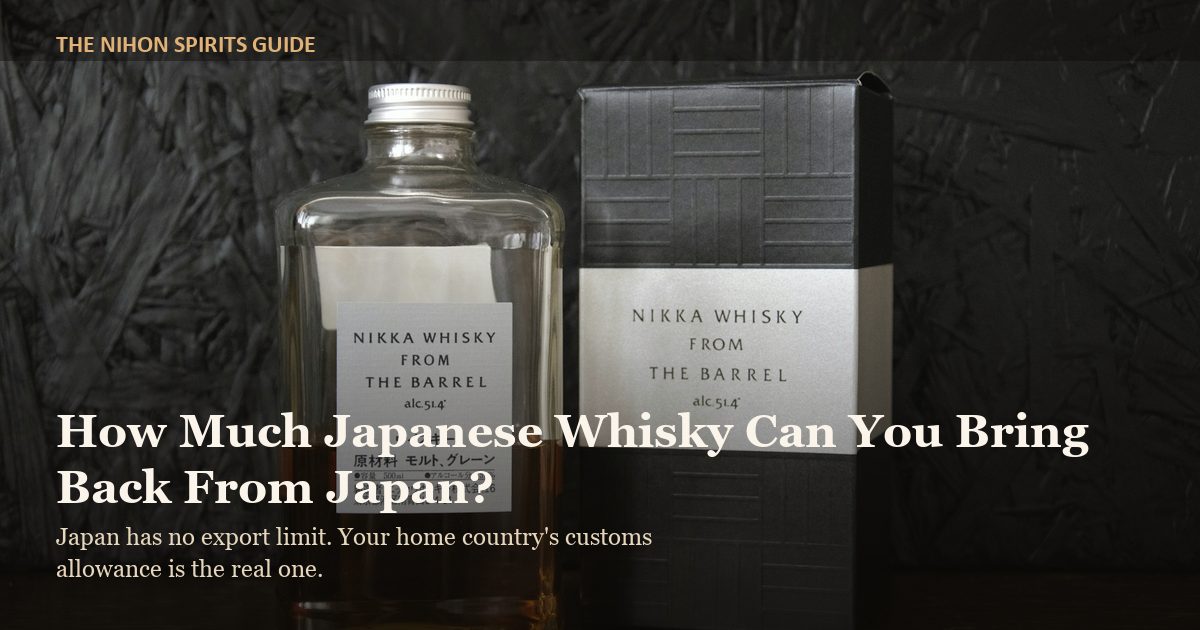
Quick answer: Japan itself doesn’t limit how much whisky you can take out of the country when you leave. The real ceiling is whatever your home country’s customs allowance is, and that number is different in the US, the UK, the EU, and Australia. Go over it and you don’t get turned away, you just owe duty and tax on the amount above the limit, plus you have to actually declare it. There’s no universal “3 bottles” rule, no matter how often that number gets repeated online.
Some of the retailers we link to, including Amazon, are partners who may pay us when you buy through them. This doesn’t change which products we recommend. How this works.
Japan’s Side: There’s No Export Limit
Japanese customs doesn’t place a quantity cap on alcohol leaving the country in a traveler’s luggage. Multiple independent travel sources confirm this, and Japan Customs’ own English-language pages describe restrictions for goods arriving in Japan, not goods departing. If you buy ten bottles of whisky at a shop in Tokyo the day before your flight, nothing at Japanese departure control stops you from packing all ten.
That’s exactly why this question trips people up. The absence of a limit on the Japan side makes it easy to assume there isn’t one anywhere, and then to get an unpleasant surprise at your own country’s customs desk. The constraint that actually matters is the one waiting for you at home.
Duty-Free Alcohol Allowances by Country
These are the personal, duty-free allowances for travelers bringing alcohol back for their own use, not for resale. Every country listed lets you bring back more than this if you’re willing to declare it and pay duty, so none of these numbers are a hard cap. Figures below are current as of 2026; customs rules change, so confirm with the official source linked in each section before you travel.
| Destination | Duty-free spirits allowance | Minimum age | Official source |
|---|---|---|---|
| United States | 1 liter per person (federal baseline; state law can be stricter) | 21 | U.S. Customs and Border Protection |
| United Kingdom (Great Britain) | 4 liters of spirits over 22% ABV, or a split with the 9-liter allowance for weaker drinks | 17 | HM Revenue & Customs (gov.uk) |
| European Union | 1 liter of spirits over 22% ABV (varies by member state, some allow more) | Set by member state | European Commission (Your Europe) |
| Australia | 2.25 liters of alcoholic beverages of any type | 18 | Australian Border Force |
United States
U.S. Customs and Border Protection sets the federal duty-free personal exemption at one liter of alcohol per traveler, for anyone 21 or older bringing it back for personal use rather than resale. That’s the number most people quote, and it’s correct as a baseline, but it’s not the whole picture.
Two things trip people up specifically on the US route:
- You can bring back more than one liter. It isn’t a hard limit, it’s the point where duty-free treatment ends. Anything beyond it is dutiable, meaning you’ll owe a combination of customs duty and federal excise tax on the excess, calculated at the port of entry.
- State law can override the federal allowance, and CBP enforces it. Alcohol is regulated at the state level in the US, and some states cap how much you can personally import without a license, independent of what federal customs allows. CBP’s own guidance tells travelers to check the alcohol laws of the state where they’re arriving before relying on the federal number. If your connecting flight lands you in a stricter state, that state’s limit is what applies, not the more generous one you might have read about elsewhere.
Practically: if you’re bringing back two or three bottles of Japanese whisky for yourself and not planning to resell any of it, you’re very unlikely to have a real problem at most ports of entry. Declare it, expect to pay a modest amount of duty on anything past the first liter, and check your arrival state’s rules if you’re bringing back a genuinely large haul.
United Kingdom
Entering Great Britain (England, Scotland, and Wales; Northern Ireland follows a different set of rules tied to its EU-aligned status) with spirits, HM Revenue and Customs allows 4 liters of spirits over 22% ABV duty-free. That allowance can also be split proportionally with a separate 9-liter allowance for fortified wine, sparkling wine, or other drinks up to 22% ABV. For most travelers bringing back bottled whisky, the straightforward version is: up to 4 liters of Japanese whisky, duty-free.
Wine has its own, separate 18-liter allowance for still wine, and beer has a 42-liter allowance. These don’t combine with the spirits allowance. And critically, if you go over any single category, HMRC’s rule is that you pay duty and tax on the entire amount in that category, not just the portion over the limit. Bringing back 19 liters of wine means paying duty on all 19, not just the 1 liter over.
You must declare alcohol above your allowance before you arrive in the UK, and there’s no personal allowance at all for travelers under 17.
European Union
If you’re flying home to an EU country from Japan, you’re arriving from outside the EU, so the standard non-EU traveler allowance applies. The baseline is 1 liter of spirits over 22% ABV, which can be swapped proportionally for 2 liters of fortified or sparkling wine at or under 22% ABV. That’s on top of separate allowances for still wine and beer.
The wrinkle with the EU is that these are minimum guideline levels the EU sets, and individual member states are free to set a higher personal allowance for travelers arriving at their own airports. In practice this means the exact number can differ depending on whether you land in Paris, Frankfurt, or Amsterdam, so if you’re bringing back close to the limit, it’s worth checking the specific customs page for whichever EU country you’re actually landing in rather than assuming the EU-wide baseline is the final word.
Australia
The Australian Border Force sets a single, simple number: 2.25 liters of alcoholic beverages of any type, duty-free, for travelers 18 and over. Unlike the US, UK, and EU, there’s no separate carve-out by drink type, spirits, wine, and beer all count against the same 2.25-liter total.
One helpful detail for families: if you’re traveling together on the same flight, you can pool your individual allowances. Two adults traveling as a family unit effectively get 4.5 liters between them, provided you go through customs clearance together. As with the other countries here, exceeding the limit doesn’t mean confiscation, it means duty and tax apply to everything in that category, not just the excess.
Packing and Airline Rules Matter Too, Not Just Customs
Customs allowances govern how much you can bring in duty-free. A separate set of rules, set by aviation safety regulators and airlines rather than customs authorities, governs how you’re allowed to pack it on the plane in the first place, and this trips up just as many travelers.
The US TSA’s rule, which mirrors the international dangerous-goods standard most airlines follow: alcoholic beverages at 24% ABV or less have no special packing limit in checked baggage. Between 24% and 70% ABV, which covers the vast majority of Japanese whisky, you’re limited to 5 liters per passenger in checked baggage, and the bottles need to be in their original, unopened retail packaging. Above 70% ABV, it’s not allowed in either checked or carry-on baggage at all. If you’re flying a non-US airline, confirm the specific limit with them, but this 24/70/5-liter structure is close to the global standard.
Carry-on is a different problem entirely, separate from the ABV rules above: standard international airport security limits any liquid in carry-on to 100ml containers, full stop, regardless of alcohol content. The workaround is buying at airport duty-free after security, where bottles are sealed in a tamper-evident bag with your receipt visible. That seal is generally honored through your first flight, but if your itinerary includes a connecting flight with a second security screening, whether that seal is still honored depends on the connecting airport’s own rules. It’s worth checking before you buy a bottle at Narita or Haneda duty-free specifically to carry on, if your route has a layover.
Because full-size bottles have to go in checked baggage, the realistic risk on the way home isn’t customs, it’s breakage. A padded, sealable bottle sleeve costs less than one broken bottle soaking the rest of your suitcase. Two well-reviewed options:

Liquid Spectrum Bottle Shield (6-Pack)
Double-layer bubble sleeve with a sealed closure, listed as fitting whiskey bottles up to 1 liter. 4.8★ (240 ratings).

Conilly Inflatable Bottle Protector Bags (10-Pack)
Air-column bags that inflate around the bottle, hand pump included. 4.6★ (1,335 ratings).
One caveat from buyer reviews of fixed-size sleeves: “some liquor bottle fit, but not all.” Standard 700ml and 750ml bottles are the safe case; a wide or unusually shaped bottle is worth test-fitting before you pack, and the inflatable bags don’t depend on a fixed sleeve width.
A Few Practical Tips
- Buy in Japan, but check your own country’s allowance before you shop, not after. Our Japanese airport duty-free guide covers where to actually shop and which bottles are worth it; this article is the piece that tells you how much you can bring home once you’ve picked something.
- Keep your receipts. If you’re anywhere near a country’s allowance, having proof of purchase price makes the customs declaration process faster and helps calculate any duty owed accurately.
- Declare honestly rather than guessing whether you’re under the limit. Most countries’ penalties are aimed at people who don’t declare at all, not at people who declare slightly over their allowance and pay the resulting duty.
- If you’re chasing a specific bottle that’s genuinely cheaper in Japan than at home, our guide to buying whisky in Japan breaks down where the real price gaps are, since not every bottle is actually a better deal once you account for what you’d have paid at home anyway.
FAQ
Can I bring back more than one bottle of Japanese whisky?
Yes. None of the allowances above are a bottle cap, they’re volume allowances, and every country listed lets you bring back more than the duty-free amount if you declare it and pay the applicable duty and tax.
Do I need to declare Japanese whisky if I’m under my country’s allowance?
Generally no, if you’re within your personal duty-free allowance you don’t owe duty on it, though some countries still ask you to indicate what you’re carrying on an arrival form. If you’re at or over the allowance, declare it.
What actually happens if I bring back more than the allowance?
In every country covered here, going over the allowance means paying duty and tax, not confiscation or a fine, as long as you declare it honestly. Not declaring alcohol you’re carrying over the limit is the part that risks penalties.
Is the “3 bottles” rule real?
Not as a universal standard. Three 750ml bottles works out to 2.25 liters, which happens to match Australia’s allowance exactly, but it doesn’t match the US (1 liter), the UK (4 liters), or the EU (1 liter) allowances at all. It’s a number that got generalized from one specific country’s rule.
Does Japan limit how much sake I can take out too?
No, the same answer applies: Japan doesn’t place an export quantity limit on alcohol, sake included. But the allowance you use at your destination may not be the same one as whisky. Sake is usually around 15-16% ABV, under the 22% ABV line the UK and EU use to separate “spirits” from the more generous wine and lower-strength drinks category, so it can fall under a different allowance than whisky there. The US and Australian allowances don’t split by strength the same way, so the number in the table above applies either way.
Final Thoughts
The short version: nobody in Japan is going to stop you from packing however much whisky you want. The number that actually matters is your own country’s duty-free allowance, and that number is 1 liter in the US, 4 liters in the UK, 1 liter as the EU baseline (with some member states allowing more), and 2.25 liters in Australia. Go over it and you pay duty rather than getting turned away, as long as you declare it. Pair that with the 24%/70%/5-liter packing rule most airlines apply to checked baggage, and you have everything you need to actually plan a whisky-shopping trip instead of guessing at a “3 bottles” rule that isn’t real anywhere except, coincidentally, Australia.
Keep Reading
- Filling your allowance with plum wine? See the best umeshu to buy and our Choya umeshu review.