
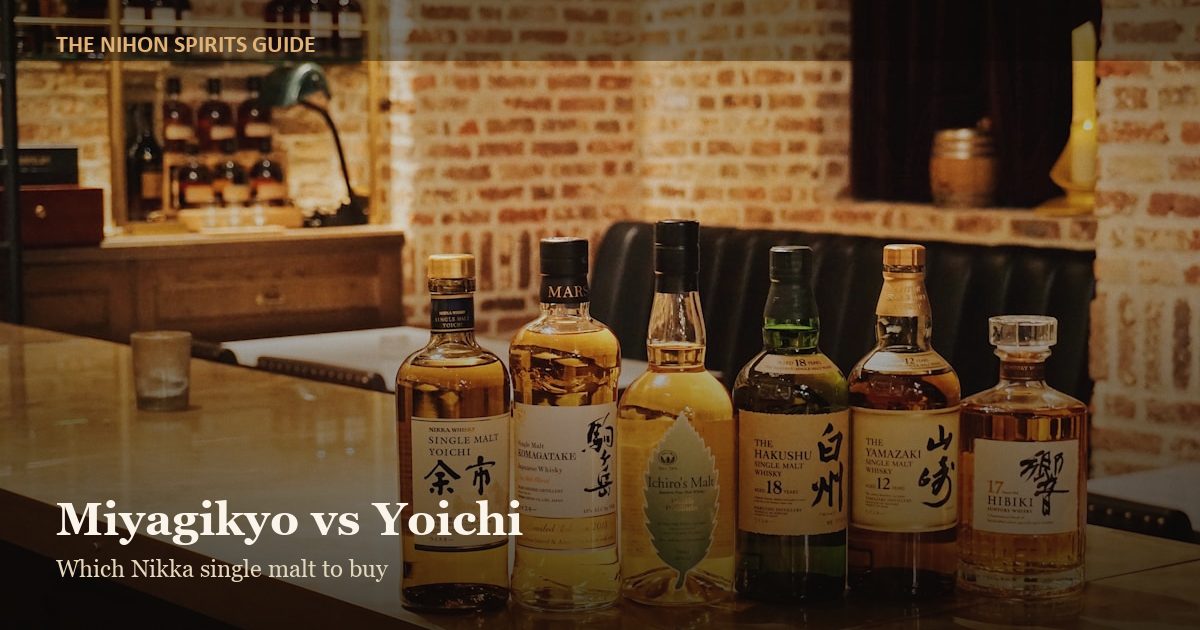
Quick answer: Miyagikyo and Yoichi are Nikka’s two distilleries, built specifically to produce opposite styles of single malt. Yoichi is smoky, briny, and coastal, distilled in coal-fired pot stills on the coast of Hokkaido. Miyagikyo is fruitier and softer, matured mainly in ex-sherry casks near Sendai. Neither is the “better” bottle; they’re built to taste different on purpose, and the right one depends entirely on whether you want a peated or unpeated Japanese single malt.
Some of the retailers we link to are partners who may pay us when you buy through them. This doesn’t change which bottles we recommend. How this works.
Miyagikyo vs Yoichi: Comparison at a Glance
| Yoichi | Miyagikyo | |
|---|---|---|
| Founded | 1934 (Nikka’s founding distillery) | 1969 (Nikka’s second distillery) |
| Location | Coastal Hokkaido | Near Sendai, inland |
| Still type | Coal-fired pot stills | Steam-heated pot stills |
| Cask profile | Mixed, no dominant sherry lean | Leans heavily on ex-sherry, with some ex-bourbon and new American oak |
| Peat character | Pronounced: smoke, brine, sea moss | Faint background smoke at most |
| Flavor profile | Smoky, briny, dark fruit, oak char | Fruity, honeyed, dried fruit, light spice |
| Standard ABV | 45% | 45% |
| Typical US price | $80-100 | Comparable, availability more inconsistent |
Why Nikka Built Two Distilleries With Opposite Styles
Yoichi came first. Nikka’s founder, Masataka Taketsuru, built it in 1934 on Hokkaido’s coast specifically because he believed the site’s climate would let him recreate the conditions he’d studied in Scotland. Its coal-fired pot stills are still unusual even by Scotch standards today, a production detail that’s a real, documented part of why Yoichi tastes the way it does, not a marketing flourish.
Miyagikyo came 35 years later, in 1969, built near Sendai for a deliberate reason: to produce a lighter, fruitier style that Yoichi’s heavier, peated character couldn’t cover. Where Yoichi uses coal-direct-fired stills, Miyagikyo uses steam heat, a gentler process that produces a cleaner, fruitier spirit before cask maturation even enters the picture. Our full Nikka Yoichi review and Nikka Miyagikyo review cover each distillery’s standard release in depth; this comparison focuses on how they actually differ.
The Flavor Difference: Peated Coastal vs Fruity Sherry-Cask
Yoichi opens smoky and malty, with independent reviewers consistently describing campfire smoke, sea moss, and brine, more medicinal and coastal than a typical Highland Scotch but not as aggressive as a heavily peated Islay. Underneath that smoke sits genuinely rich malt with dark fruit, smoky honey, and apricot.
Miyagikyo opens with barley-sugar sweetness moving into tangerine, pear, and a touch of banana, a fruit-forward character reviewers trace back to its sherry-cask-heavy maturation, alongside dried fruit and light spice. Most tasting notes describe faint background smoke at most, a world away from Yoichi’s pronounced peat.
That gap isn’t subtle. If you’ve had a peated Scotch and liked it, Yoichi is the Nikka bottle built for you. If peat has never appealed, or you gravitate toward sherry-forward whisky like a good Speyside, Miyagikyo is the closer match. This isn’t a “which is more refined” question the way Ginjo vs Daiginjo is on the sake side; it’s closer to choosing between two different Scotch regions.
Both Are Genuine JSLMA-Compliant Single Malts
Neither bottle raises the authenticity questions covered in our Suntory Toki authenticity check. Both are distilled, matured, and bottled entirely at their respective Nikka distilleries in Japan, satisfying the JSLMA’s self-regulatory standard without qualification. The standard, age-statement-free release of each is bottled at 45% ABV. Where they differ isn’t authenticity; it’s house style, by design.
How They Compare to Suntory’s Single Malts
Suntory’s Yamazaki and Hakushu lean on Mizunara oak for a signature sandalwood-and-coconut character that neither Nikka distillery replicates. Miyagikyo’s sherry-cask-heavy maturation produces a different kind of fruit-forward profile, built around dried fruit and light spice rather than Mizunara’s aromatic wood notes. Yoichi’s peated, coastal character has no real Suntory equivalent at all; Suntory doesn’t currently bottle anything built around that flavor profile. If you’re deciding between the two big Japanese whisky houses rather than just the two Nikka distilleries, our Yamazaki 12 and Hakushu 12 reviews cover the Suntory side, and our Nikka vs Suntory guide covers the brand-level question directly.
Miyagikyo vs Yoichi: Which Should You Buy?
- You’ve enjoyed a peated Scotch before: Yoichi. It’s the closest thing Nikka makes to that style, and independent reviewers regularly rank it as more complex than its price point suggests.
- Peat has never appealed to you, or you prefer sherry-forward whisky: Miyagikyo. Its fruit-and-spice profile is the more broadly approachable of the two for someone who doesn’t already like smoke in their glass.
- You want the more widely available bottle in most markets outside Japan: check current stock either way; both distilleries have inconsistent international availability, but Yoichi tends to show up more often given its longer export history and stronger name recognition.
- You want to try both to actually compare them yourself: that’s a reasonable call, since the difference is large enough that tasting notes alone may undersell how different they are side by side.
Shop at The Whisky Exchange: Nikka Miyagikyo · Nikka Yoichi →
FAQ
Is Miyagikyo better than Yoichi?
Neither is objectively better; they’re built to taste opposite. Yoichi is smoky, briny, and peated from coal-fired stills; Miyagikyo is fruitier and matured mainly in sherry casks with little smoke. Which one you’ll prefer depends on whether you like peated whisky at all.
Which is more expensive, Miyagikyo or Yoichi?
Prices are generally comparable where both are available, commonly $80-100 in the US. Miyagikyo’s bigger issue is consistency of supply rather than price; it shows up less reliably in some markets than Yoichi does.
Is Yoichi peated like an Islay Scotch?
It’s genuinely peated, but reviewers typically describe it as more moderate than a heavily peated Islay, closer to a toned-down version with its own coastal, briny character rather than a direct Islay copy.
What about Taketsuru? How does it fit with Miyagikyo and Yoichi?
Taketsuru is a blended malt combining whisky from both Yoichi and Miyagikyo, rather than a third distillery. It’s built to sit stylistically between the two, though international availability for it is even more limited than for either single-distillery bottle.
Are both available in the same markets?
Not consistently. Both have inconsistent distribution outside Japan, and availability can vary significantly by country and even by retailer within the same country. Check current stock before assuming either one is easy to find.
Final Thoughts
Miyagikyo vs Yoichi isn’t really a “which is better” comparison; it’s closer to asking whether you want a peated or unpeated whisky, then letting Nikka’s two distilleries answer that question in opposite directions on purpose. Yoichi fills a genuinely peated, coastal niche that Suntory doesn’t touch. Miyagikyo is the fruitier, sherry-forward alternative for drinkers who want Japanese single malt without the smoke. If you’re only going to try one, pick based on whether peat appeals to you at all; if you can find both, they’re different enough to be worth comparing directly rather than picking blind. For where these two distilleries and the rest of the category stand against the JSLMA authenticity standard, see our Real Japanese Whisky complete list.