
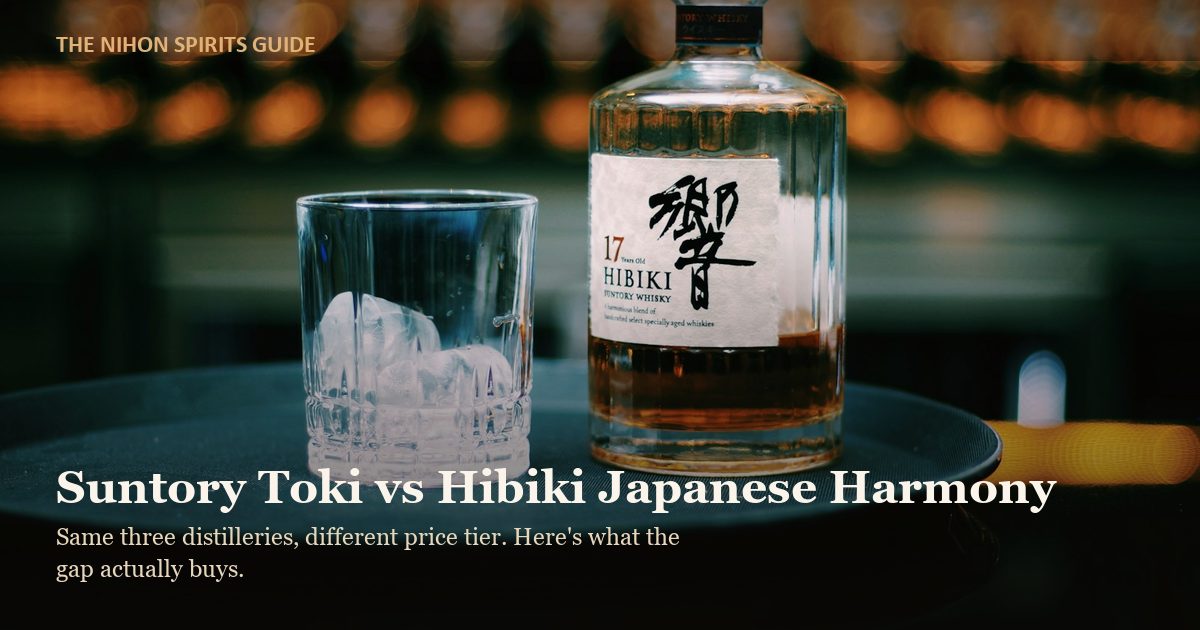
Quick answer: Toki vs Hibiki isn’t really a fight between two unrelated bottles — both are genuine Suntory blends built from the same three distilleries (Yamazaki, Hakushu, and Chita), and both pass the JSLMA standard for real Japanese whisky. The real difference is what happens after distillation: Hibiki Japanese Harmony draws on five cask types, including rare Mizunara oak, and costs roughly two to three times as much. If you mainly drink highballs, get Toki. If you want a special-occasion sipper or a gift bottle, get Hibiki Harmony.
Toki vs Hibiki: Comparison at a Glance
| Suntory Toki | Hibiki Japanese Harmony | |
|---|---|---|
| Blend components | Yamazaki + Hakushu malt, Chita grain | Yamazaki + Hakushu malt, Chita grain |
| Cask program | Standard maturation casks | 5 cask types, including ex-bourbon, sherry, and Mizunara oak |
| ABV | 43% | 43% |
| Age statement | None (NAS) | None (NAS) |
| Price (750ml) | ~$30–40 | ~$80–90 MSRP, $90–130 street |
| JSLMA compliant | Yes | Yes |
| Built for | Highballs, mixing | Neat, on the rocks, or highball |
| Best for | Everyday drinking | Special occasions, gifting |
Prices vary by state and retailer and change often — treat these as a starting point, not a quote.
Suntory Toki: The Everyday Blend
Toki blends single malt whisky from Yamazaki and Hakushu with single grain whisky from Chita, bottled at 43% ABV with no age statement. It’s genuinely distilled, aged, and bottled entirely in Japan under Suntory’s own production, which is exactly what the JSLMA’s self-regulatory standard for “Japanese whisky” requires — our Suntory Toki authenticity check walks through that standard point by point. Suntory built it around the highball specifically: fresh green apple and lemon peel lead, followed by white grape and a soft floral lift, with honey and vanilla underneath and just enough light oak to remind you it’s whisky. Our full Suntory Toki review covers the tasting notes and serving method in more depth.
Pros:
- Widely available at a genuinely low price for authenticated Japanese whisky
- Holds its citrus and floral character in a highball better than most bottles this price
- Approachable first bottle if you’ve never tried Japanese whisky before
Cons:
- Thin and unremarkable neat, without ice or a mixer
- Not built to reward slow, contemplative sipping
- Doesn’t carry the name recognition or gifting appeal of Hibiki
Bottom line: the bottle to keep stocked for everyday drinking, not the one to hand someone as a special occasion gift.
Hibiki Japanese Harmony: The Premium Blend
Harmony blends the same three sources as Toki — Yamazaki and Hakushu malt, Chita grain — but matures the components across five cask types, including ex-bourbon, sherry, and rare Mizunara oak, before blending. It’s also bottled at 43% ABV with no age statement, having replaced the age-stated Hibiki 12 in 2015 once international demand outpaced the aged malt stock needed to keep a number on the label. The result opens with delicate rose and orange blossom over honey, orange peel, and white chocolate, with vanilla and sandalwood from the American oak and a faint whisper of smoke from the Mizunara component. Our full Hibiki Japanese Harmony review covers the tasting notes, history, and serving recommendations in more depth.
Pros:
- Genuinely excellent balance and blending craft — the most recognizable name in Japanese whisky for a reason beyond marketing
- Five cask types, including scarce Mizunara oak, add a layered complexity Toki’s simpler maturation doesn’t attempt
- Works equally well neat, on the rocks, or as a highball
- The bottle and packaging make it a genuine gift-worthy pour
Cons:
- Two to three times Toki’s price for the same three source distilleries
- Subtle to the point of underwhelming if you’re used to bolder bourbon or heavily peated scotch
- No age statement, which still puts some buyers off even though it doesn’t affect JSLMA compliance
Bottom line: worth the premium if you want a polished, gift-worthy sipper — not the bottle to reach for if you’re just mixing highballs on a Tuesday.
What the Price Difference Actually Buys You
The overlap in raw materials is real: Toki and Hibiki Harmony draw on the exact same three Suntory-owned sources — Yamazaki malt, Hakushu malt, and Chita grain. Neither bottle is secretly a different, unrelated whisky wearing a fancier label. So what does roughly $50–90 extra actually pay for?
Mainly two things. First, cask diversity: Harmony’s five cask types, including sherry and Mizunara, cost more to source and manage than Toki’s more standard maturation program, and Mizunara oak specifically is scarce and prone to leaking during cooperage, which keeps its use limited across the whole industry. Second, blend precision and reserve stock: a blend built for subtlety and layering, the way Harmony is, generally draws on a wider range of aged component whiskies than one built primarily to survive dilution with soda water. That said, some of the gap is brand positioning rather than production cost — Hibiki carries cultural cachet as Suntory’s flagship blend that Toki, a newer, mixer-focused release, was never designed to compete with. You’re not being scammed at either price point, but you’re not paying purely for ingredients either.
Where Yamazaki Fits In
If you’re also weighing Yamazaki against these two, the comparison changes shape: Yamazaki 12 is a single malt made entirely at one distillery, not a blend of multiple sources like Toki or Hibiki. It shares Mizunara-aged DNA with Harmony but skews sweeter and more tropical, and currently runs $180–240 at US retail after two recent Suntory price increases — well above either blend covered here. Whether Hibiki or Yamazaki is “better” comes down to whether you want a single distillery’s character (Yamazaki) or a blender’s composition of three (Hibiki); neither is a clearer answer than the other.
Toki vs Hibiki: Which One Should You Buy?
- Mainly drink highballs and want a bottle to keep stocked: get Suntory Toki.
- Want a special-occasion sipper or a gift for someone whose taste you don’t know well: get Hibiki Japanese Harmony.
- Curious what the step up actually tastes like before committing: buy one bottle of Harmony to try neat, and keep Toki around for mixed drinks — there’s no need to choose only one.
- Want more intensity than either offers without leaving Suntory’s catalog: Toki Black adds peated Hakushu malt to Toki’s base for a smokier variant at close to the original’s price.
- Deciding whether Harmony is worth it at all versus other options in the same bracket: our Hibiki Harmony alternatives guide covers five bottles worth comparing it against.
FAQ
Is Toki basically a cheaper version of Hibiki?
Not exactly. They share the same three source distilleries, but Harmony’s five-cask maturation program (including Mizunara oak) and its role as Suntory’s flagship blend make it a genuinely different product, not just a discounted version of the same recipe.
What’s the actual difference between Toki and Hibiki?
Cask maturation and blending intent. Toki is built primarily for highballs from more standard casks; Hibiki Harmony draws on five cask types, including sherry and rare Mizunara oak, for a more layered, sipping-focused profile.
Is Hibiki worth double or triple the price of Toki?
If you mostly drink whisky mixed with soda water, no — Toki does that job as well or better for a fraction of the cost. If you want a neat sipper with more complexity and gifting appeal, Harmony’s premium is defensible, even if not all of it reflects raw production cost.
Which is better, Hibiki or Yamazaki?
Different formats rather than a clear winner. Hibiki Harmony is a three-distillery blend built for balance; Yamazaki 12 is a single malt built entirely at one distillery and currently costs roughly double Harmony’s street price. See our Yamazaki 12 review for the full picture.
Is Toki real Japanese whisky, or a marketing claim?
Real. Both Toki and Hibiki Harmony meet the JSLMA’s 2021 self-regulatory standard — mashed, fermented, distilled, aged at least three years in wood, and bottled entirely in Japan. See our complete list of every Japanese whisky we’ve checked against the standard for how they compare to other bottles.
Final Thoughts
Toki vs Hibiki isn’t a contest between a real Japanese whisky and a lesser imitation — both are genuine, JSLMA-compliant blends from the same three Suntory distilleries. The gap between them comes down to cask maturation, blending precision, and brand positioning, not authenticity. Keep Toki on hand for highballs and mixed drinks; reach for Hibiki Harmony when the occasion calls for something to sip slowly or hand to someone as a gift. For more on how Toki holds up specifically as a highball whisky, see our guide to the best Japanese whisky for highballs, and for the full field of bottles under $100, see our Japanese whisky under $100 guide. Shop Suntory Toki or Hibiki Japanese Harmony at The Whisky Exchange.